Sunday, June 10, 2018

The 6 Best Off-Road Trailers (Updated for 2018) • Gear Patrol

The 6 Best Off-Road Trailers (Updated for 2018) • Gear Patrol

The 6 Best Off-Road Trailers of 2018

Last Updated January, 2018: This post has been updated with new picks for 2018.

There was once a time when exploring the great outdoors on wheels meant one of two things. You either went the minimalist route — drove your 4×4 off-road and camped in a tent route with nothing but the bare essentials — or you lived in the lap of luxury in a massive RV, parked at the trailhead and hoofed it to really explore the surrounding nature. Today, a beautiful market has developed at the intersection of condo-on-wheels-style RV adventures and the ol' fashioned home-is-where-you-pitch-your-tent method. Off-road trailers are the answer.

Some you live in, some you live on, while still others act as an extended trunk complete with a mobile kitchenette, adding a bit of luxury to a weekend spent roughing it. Admittedly, some of the larger trailers can get reasonably ritzy, while others go totally spartan, stripped down to only what's necessary. Regardless of how pampered you like to be, the best off-road trailers of 2018 will provide you the mobile campsite you desire.

Prefer to skip directly to the picks? Click right here.

The Short List

Best All-Around Off-Road Trailer: Patriot Campers X1

Winner of Best Camper Trailer of the Year five years in a row, the Patriot Campers X1 is an all-around package that provides luxury, comfort and utility, all in a compact, lightweight design. The galvinized chassis, marine-grade aluminum and independent coil trailing arm suspension with twin shock absorbers at each wheel means it will go almost anywhere your overlander can without seeming like it's about to snap off at the hitch. And, as of 2017 the X1 is available in America through Patriot camper's US distributor Exploration Outfitters.
Weight: 265 lbs
Dimensions: 11 feet, 6 feet wide, 5.8 feet high
Price: $36,990

Best Value Off-Road Trailer: Moby 1 XC Cross Country

It's neither the biggest nor most affordable trailer on the list, but in terms of size and capability, pound for pound the Moby 1 XC Cross Country is the best trailer for its price point. The longer wheelbase version can hold a queen size mattress on the roof (as well as a fold-down tent); a half galley inside perfect for daily meal prep. At 1,500 lbs the compact trailer doesn't ask too much of your tow vehicle, which, even if it's a vintage four-wheeler, should have no problem with the Moby 1 XC Cross Country in tow.
Weight: 1,200 lbs
Dimensions: 9 feet long, 4 feet wide
Price: $14,500

Buying Guide

6 Best Off-Road Trailers of 2018

Best All-Around Off-Road Trailer: Patriot Campers X1

Winner of Best Camper Trailer of the Year five years in a row, the Patriot Campers X1 is an all-around package that provides luxury, comfort and utility, all in a compact, lightweight design. The galvinized chassis, marine-grade aluminum and independent coil trailing arm suspension with twin shock absorbers at each wheel means it will go almost anywhere your overlander can without seeming like it's about to snap off at the hitch. And, as of 2017 the X1 is available in America through Patriot camper's US distributor Exploration Outfitters.

Review: "Physics is a great thing. It cuts through any marketing BS and tells us the bigger and heavier something is, the harder it's going to be to take offroading. If that's the case, the inverse must be true. A lightweight, compact trailer with good ground clearance and very little overhang must be good offroad. To that end, the X1 GT won't disappoint offroaders or physics as we currently understand it." — Dan Everett, Camper Trailer Australia

Weight: 265 lbs
Dimensions: 11 feet, 6 feet wide, 5.8 feet high
Price: $36,990

Most Well-Equipped: Lotus Caravans Tremor

Verging on RV-status, the Lotus Caravans Tremor equates to a studio apartment on wheels. Wherever you end up towing the Tremor, you won't be left wanting for anything — it takes the edge off truly roughing it with a full bed, a bathroom with a shower, gas stove, oven, sink and lounge area. If you want to take your home with you when you go exploring the farthest reaches of what America's national parks have to offer, mountain bike or kayak during the day and sleep in relative luxury, the Tremor is the off-road trailer you want.
From the manufacturer: "Premium German-made composite paneling, combined with exclusive Lotus Caravans rolled checkerplate paneling are added for strength and moisture protection. The fully equipped kitchen with Laminex Diamond Gloss laminate bench tops and comfort lounge ensure five-star luxury. Standard features include a tropical-rated Dometic fridge, a Euro-style top load washing machine, a Thetford oven, and an Ibis low-profile roof air-con."

Weight: 7705 lbs
Dimensions: 27.6 feet long, 7.6 feet wide, 9.6 feet high
Price: $53,000

Best Toy-Hauler: Turtleback Trailers Turtlebacker

The drawback to towing a camper trailer is that you can't tow anything else. Sure, you can mount skis, boards, bikes and kayaks to the roof, but what about the bigger toys? The Turtlebacker doesn't make you choose between a comfortable weekend in your camper and an adrenaline filled holiday with your side-by-side — it lets you enjoy both.
From the manufacturer: "Our newest offering is the Turtlebacker trailer, which is a dual-axle toy hauler built to combine the amenities of the Expedition Trailer ($21,995) model with the ability to carry ATVs, UTVs, Dual-Sports, two-Door Rock Crawlers and more. The base build includes a 42-gallon water tank, six-gallon water heater, shower, slide-out kitchen, stainless steel sink and stove, solar-ready electronics package and over 45 cubic feet of storage. The wide range of customizable options and add-ons further enhance the amenities and capabilities for any adventurer's needs."

Weight: 2,600lbs
Dimensions: 22 feet long, 8.5 feet wide
Price: $26,995

Best Value Off-Roader: Moby1 XC Cross Country

It's neither the biggest nor most affordable trailer on the list, but in terms of size and capability, pound for pound the Moby 1 XC Cross Country is the best trailer for its price point. The longer wheelbase version can hold a queen size mattress on the roof (as well as a fold-down tent); a half galley inside perfect for daily meal prep. At 1,500 lbs the compact trailer doesn't ask too much of your tow vehicle, which, even if it's a vintage four-wheeler, should have no problem with the Moby 1 XC Cross Country in tow.
From the manufacturer: "The new XC model comes equipped with heavy-duty rubber torsion axle system for absorbing and dampening bumps and vibrations. The XC comes standard with all-terrain tires, higher ground clearances, heavy duty fenders with cargo racks and a strengthened frame for rough conditions. Like its sibling the XTR, the XC can be fully equipped for serious extended backcountry adventure travel."

Weight: 1,200 lbs
Dimensions: 9 feet long, 4 feet long
Price: $14,50

Best Budget Trailer: VMI Offroad XTender Explorer

The VMI Offroad Xtender Explorer is the bare bones option. That's not necessarily a bad thing, especially if you're more of a fan of the minimalistic route. The Explorer equates to an extension on your trunk space for more gear and provides another platform for a second rooftop tent. Weekend jaunts up to the mountains or out to your favorite off-the-beaten-path fishing spot are where the lightweight, spartan Explorer proves its worth.
From the manufacturer: "Our base trailer, with all the quality attributes of the bigger models, can be used as a utility trailer, a camper with just the basics or tricked out to include the creature comforts. All of our trailers are built from the ground up on American soil with close attention to using American made materials. All Xtender trailers are built with aerospace and marine grade aluminum making them lightweight, strong and free of the corrosion and painting issues common with steel."

Weight: 540lbs
Dimensions: 11 feet long, 6 feet wide
Price: $6,995

Most Ready-To-Go: Air Opus

Although setting up a modern tent is incredibly easy these days, the Air Opus goes one step further. The Air Opus inflates in under 90 seconds and is live-in ready. Think of it as an open-air porch with a grill and kitchen area that can convert into small a bedroom with two full-size mattresses able to sleep four, at night. The ease of setup is a key feature for the Air Opus but having what is essentially two rooms-in-one is certainly a highlight.
Review: "The Air Opus…will more or less self-deploy in about two minutes. How? It's not quite magic, but it sure takes the effort out of things. Simply push a button, and the onboard air-compressor will inflate the so-called 'air beams,' which replace the standard hoops, until they become rigid enough to hold the tent securely in place, even in a gale." Max Taylor, GoRV

Weight: 2,870 lbs
Dimensions: 18.5 feet long, 6.8 feet wide, 4.75 feet high
Price: $24,000

6 Great Adventure Motorcycles for 2018

No matter if asphalt gives way to gravel and dirt, an adventure bike never waivers. Read the Story


_- Steve

Saturday, June 09, 2018

National Geographic: One of the Deepest Caves in the World is Even Bigger Than We Thought


One of the Deepest Caves in the World is Even Bigger Than We Thought
National Geographic

While trapped inside Mexico's Sistema Huautla by torrential flooding, cavers and scientists discovered new connections—expanding the map of the Western Hemisphere's deepest cave. Read the full story


Shared from Apple News


_- Steve

Friday, June 08, 2018

What Happens When a Bad-Tempered, Distractible Doofus Runs an Empire? | The New Yorker

What Happens When a Bad-Tempered, Distractible Doofus Runs an Empire? | The New Yorker

What Happens When a Bad-Tempered, Distractible Doofus Runs an Empire?

One of the few things that Kaiser Wilhelm II, who ruled Germany from 1888 to 1918, had a talent for was causing outrage. A particular specialty was insulting other monarchs. He called the diminutive King Victor Emmanuel III of Italy "the dwarf" in front of the king's own entourage. He called Prince (later Tsar) Ferdinand, of Bulgaria, "Fernando naso," on account of his beaky nose, and spread rumors that he was a hermaphrodite. Since Wilhelm was notably indiscreet, people always knew what he was saying behind their backs. Ferdinand had his revenge. After a visit to Germany, in 1909, during which the Kaiser slapped him on the bottom in public and then refused to apologize, Ferdinand awarded a valuable arms contract that had been promised to the Germans to a French company instead.

Not that this deterred the Kaiser. One of the many things that Wilhelm was convinced he was brilliant at, despite all evidence to the contrary, was "personal diplomacy," fixing foreign policy through one-on-one meetings with other European monarchs and statesmen. In fact, Wilhelm could do neither the personal nor the diplomacy, and these meetings rarely went well. The Kaiser viewed other people in instrumental terms, was a compulsive liar, and seemed to have a limited understanding of cause and effect. In 1890, he let lapse a long-standing defensive agreement with Russia—the German Empire's vast and sometimes threatening eastern neighbor. He judged, wrongly, that Russia was so desperate for German good will that he could keep it dangling. Instead, Russia immediately made an alliance with Germany's western neighbor and enemy, France. Wilhelm decided he would charm and manipulate Tsar Nicholas II (a "ninny" and a "whimperer," according to Wilhelm, fit only "to grow turnips") into abandoning the alliance. In 1897, Nicholas told Wilhelm to get lost; the German-Russian alliance withered.

About a decade ago, I published "George, Nicholas and Wilhelm: Three Royal Cousins and the Road to World War I," a book that was, in part, about Kaiser Wilhelm, who is probably best known for being Queen Victoria's first grandchild and for leading Germany into the First World War. Ever since Donald Trump started campaigning for President, the Kaiser has once again been on my mind—his personal failings, and the global fallout they led to.

Trump's tweets were what first reminded me of the Kaiser. Wilhelm was a compulsive speechmaker who constantly strayed off script. Even his staff couldn't stop him, though it tried, distributing copies of speeches to the German press before he'd actually given them. Unfortunately, the Austrian press printed the speeches as they were delivered, and the gaffes and insults soon circulated around Europe. "There is only one person who is master in this empire and I am not going to tolerate any other," Wilhelm liked to say, even though Germany had a democratic assembly and political parties. ("I'm the only one that matters," Trump has said.) The Kaiser reserved particular abuse for political parties that voted against his policies. "I regard every Social Democrat as an enemy of the Fatherland," he said, and he denounced the German Socialist party as a "gang of traitors." August Bebel, the Socialist party leader, said that every time the Kaiser opened his mouth, the party gained another hundred thousand votes.

When Wilhelm became emperor, in 1888, at twenty-nine years old, he was determined to be seen as tough and powerful. He fetishized the Army, surrounded himself with generals (though, like Trump, he didn't like listening to them), owned a hundred and twenty military uniforms, and wore little else. He cultivated a special severe facial expression for public occasions and photographs—there are many, as Wilhelm would send out signed photos and portrait busts to anyone who'd have one—and also a heavily waxed, upward-turned moustache that was so famous it had its own name, "Er ist Erreicht!" (It is accomplished!)

In fact, Wilhelm didn't accomplish very much. The general staff of the German Army agreed that the Kaiser couldn't "lead three soldiers over a gutter." He had neither the attention span nor the ability. "Distractions, whether they are little games with his army or navy, travelling or hunting—are everything to him," a disillusioned former mentor wrote. "He reads very little apart from newspaper cuttings, hardly writes anything himself apart from marginalia on reports and considers those talks best which are quickly over and done with." The Kaiser's entourage compiled press cuttings for him, mostly about himself, which he read as obsessively as Trump watches television. A critical story would send him into paroxysms of fury.

During Wilhelm's reign, the upper echelons of the German government began to unravel into a free-for-all, with officials wrangling against one another. "The most contradictory opinions are now urged at high and all-highest level," a German diplomat lamented. To add to the confusion, Wilhelm changed his position every five minutes. He was deeply suggestible and would defer to the last person he'd spoken to or cutting he'd read—at least until he'd spoken to the next person. "It is unendurable," a foreign minister wrote, in 1894. "Today one thing and tomorrow the next and after a few days something completely different." Wilhelm's staff and ministers resorted to manipulation, distraction, and flattery to manage him. "In order to get him to accept an idea you must act as if the idea were his," the Kaiser's closest friend, Philipp zu Eulenburg, advised his colleagues, adding, "Don't forget the sugar." (In "Fire and Fury," Michael Wolff writes that to get Trump to take an action his White House staff has to persuade him that "he had thought of it himself.")

More sinisterly, Wilhelm's patronage of the aggressive, nationalistic right left him surrounded by ministers who held a collective conviction that a European war was inevitable and even desirable. Alfred von Tirpitz, Germany's Naval chief—who realized at his first meeting with the Kaiser that he did "not live in the real world"—consciously exploited Wilhelm's envy and rage in order to extract the astronomical sums required to build a German Navy to rival Britain's, a project that created an arms race and became an intractable block to peace negotiations.

The Kaiser was susceptible but never truly controllable. He asserted his authority unpredictably, as if to prove he was still in charge, staging rogue interventions into his own advisers' policies and sacking ministers without warning. "You cannot have the faintest idea what I have prevented," his most obsequious aide, Bernhard von Bülow, complained to a friend, "and how much of my time I must devote to restoring order where our All Highest Master has created chaos."

The Kaiser's darkest secret was that every few years—after his meddling and blunders had exposed his incompetence or resulted in a crisis—he would suffer a full-blown collapse. His entourage would scrape him off the floor, and he would retire to one of his palaces, where, prostrate, he would weep and complain that he'd been victimized. After the moaning came the pacing, in uncharacteristic silence. Occasionally he would give way to tears. Gradually he would recalibrate his sense of reality—or unreality—and after a few weeks would bounce up again, as boisterous and obstreperous as ever.

I spent six years writing my book about Wilhelm and his cousins, King George V, of England, and Tsar Nicholas II, and the Kaiser's egotism and eccentricity made him by far the most entertaining of the three to write about. After a while, though, living with Wilhelm—as you do when you write about another person over a long period—became onerous. It was dispiriting, even oppressive, to spend so much time around someone who never learned, and never changed.

The Kaiser wasn't singly responsible for the First World War, but his actions and choices helped to bring it on. If international conflict is around the corner, it would seem that you really don't want a narcissist in control of a global power. Wilhelm's touchiness, his unpredictability, his need to be acknowledged: these things struck a chord with elements in Germany, which was in a kind of adolescent spasm—quick to perceive slights, excited by the idea of flexing its muscles, filled with a sense of entitlement. At the same time, Wilhelm's posturing raised tensions in Europe. His clumsy personal diplomacy created suspicion. His alliance with the vitriolic right and his slavish admiration for the Army inched the country closer and closer to war. Once the war was actually upon him, the government and military effectively swept the Kaiser aside. And the gravest damage occurred only after Wilhelm abdicated, in November of 1918. (He spent the rest of his life—he survived until 1941—in central Holland.) The defeated Germany sank into years of depression, resentments sharpened, the toxic lie that Germany had been "robbed" of its rightful victory in the war took hold. The rest, as they say, is history.

I'm not suggesting that Trump is about to start the Third World War. But recent foreign developments—the wild swings with North Korea, the ditching of the Iran nuclear deal, the threat of a trade war with China—suggest upheavals that could quickly grow out of American control. Some of Trump's critics suppose that these escalating crises might cause him to loosen, or even lose, his grip on the Presidency. The real lesson of Kaiser Wilhelm II, however, may be that Trump's leaving office might not be the end of the problems he may bring on or exacerbate—it may be only the beginning.


_- Steve

15 Sci-Fi Books To Read If You Need A Break From Dystopian Novels


15 Sci-Fi Books To Read If You Need A Break From Dystopian Novels
https://www.bustle.com/p/15-sci-fi-books-to-read-if-you-need-a-break-from-dystopian-novels-9224509

Sent from Flipboard


_- Steve

Thursday, June 07, 2018

Monday, June 04, 2018

Review: ‘The Book of Why’ Examines the Science of Cause and Effect - The New York Times

Review: 'The Book of Why' Examines the Science of Cause and Effect - The New York Times

Review: 'The Book of Why' Examines the Science of Cause and Effect

"The Book of Why" charts the recent history of a subject that has preoccupied philosophers at least since Aristotle.Basic Books

Everyone knows that the cock's crowing at dawn does not "cause" the sun to rise. Conversely, we have equal confidence "that flipping a switch will cause a light to turn on or off and that a sultry summer afternoon will cause sales to go up at the local ice cream parlor." Such intuitions are integral to countless practical and moral judgments that fill our daily lives. And yet, as Prof. Judea Pearl and the science writer Dana Mackenzie note in their illuminating new work, "The Book of Why: The New Science of Cause and Effect," scientists and statisticians lacked a common language until recently to distinguish between these very different kinds of observation. Indeed, within academia, "causal vocabulary was virtually prohibited for more than half a century."

The absence of an accepted scientific approach to analyzing cause and effect is not merely of historical or theoretical interest. It explains the delay in the surgeon general's reports on smoking, for example, and likely led to untold avoidable early deaths. New modeling tools have vastly expanded what can be learned from the proliferation of "big data" and will define the potential reach of artificial intelligence more broadly.

The subject of causation has preoccupied philosophers at least since Aristotle. Professor Pearl has deftly used the arc of his own career — first at RCA Laboratories and for the last 50 years at the University of California, Los Angeles (initially in the engineering department and since 1970 in computer science) — to chart the recent history of the subject.

This period broadly coincides with what Professor Pearl terms "the causal revolution." Three ascending rungs of what he calls the "ladder of causation" serve as the central metaphor driving the narrative of "The Book of Why." The "revolution" charted in the book, and in which Professor Pearl and his disciples played a crucial role, is what has allowed researchers across a vast range of disciplines to move beyond the first rung of the causal ladder, where they had been perennially stuck.

This lowest rung deals simply with observation — basically looking for regularities in past behavior. Professor Pearl places "present-day learning machines squarely on rung one." While it is true that the explosion of computing power and accessible deep data sets have yielded many surprising and important results, the mechanics still operate "in much the same way that a statistician tries to fit a line to a collection of points."

"Deep neural networks have added many layers of complexity of the fitted function, but raw data still drives the fitting process," according to Professor Pearl. The causal revolution is what has enabled researchers to explore the higher rungs of the ladder.

The second rung of the ladder of causation moves from seeing to doing. That is, it goes from asking what happened to asking what would happen based on possible interventions. Professor Pearl notes that "many scientists have been traumatized to learn that none of the methods they learned in statistics is sufficient to articulate, let alone answer, a simple question like 'What happens if we double the price?'" "The Book of Why" provides a detailed explanation and history of how and when a model alone can answer such questions in the absence of live experiments.

The top rung of the ladder involves something called "counterfactual" questions: What would the world be like if a different path had been taken? These are "the building blocks of moral behavior as well as scientific thought." The ability to look backward and imagine what could have been governs our judgments on success and failure, right and wrong.

Once considered a defining characteristic of humanity, in recent decades these topics have not escaped the reach of increasingly complex modeling tools. Those tools have been applied to varied social and scientific problems, including the efficacy of medical procedures, the impact of climate change and the usefulness of social policies.

The Professor Pearl who emerges from the pages of "The Book of Why" brims with the joy of discovery and pride in his students and colleagues. He concedes, however, that his inclination is never to use words when an equation will do: "To me, a formula is a baked idea. Words are ideas in the oven." The resulting book is not always fully accessible to readers who do not share the author's fondness for equations.

The sometimes challenging technical aspects of the book should not dissuade anyone interested in the promise of intelligent systems. "The Book of Why" not only delivers a valuable lesson on the history of ideas but provides the conceptual tools needed to judge just what big data can and cannot deliver. Notably, "causal questions can never be answered from data alone."

While it is "easy to understand why some people would see data mining as the finish rather than the first step," Professor Pearl reminds us that the most important questions will always require "us, as well as future machines," to engage in the "work of having to consider and articulate substantive assumptions about how the world operates."

Despite this well-considered skepticism, Professor Pearl is remarkably optimistic about what artificial intelligence can achieve and even whether we can make machines that are capable of distinguishing good and evil. Regardless of whether one agrees with these provocative conclusions, we can all hope that in any counterfactual world in which that is the case, programmers with the humanity of Professor Pearl will be in charge.

Jonathan A. Knee is professor of professional practice at Columbia Business School and a senior adviser at Evercore Partners. His latest book is "Class Clowns: How the Smartest Investors Lost Billions in Education."


_- Steve

Saturday, June 02, 2018

Networks through History: From Ancient Hierarchies to Modern Online Communities

Networks through History: From Ancient Hierarchies to Modern Online Communities
Subsequent research suggests that the national degree of separation is closer to five than six. The number is 4.6 for directors of Fortune 1000 companies and 3.52 for Facebook users. Of course, this is only a restricted version of closeness centrality.

Networks through History: From Ancient Hierarchies to Modern Online Communities

By James Case

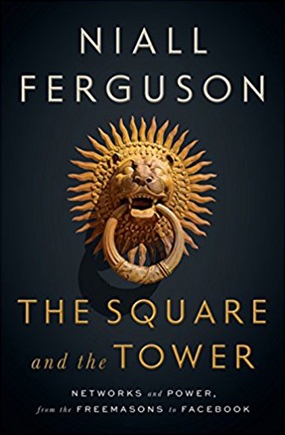
The Square and the Tower: Networks and Power, from the Freemasons to Facebook. By Niall Ferguson. Penguin Press, New York, NY, January 2018. 592 pages, $30.00.

The Square and the Tower: Networks and Power, from the Freemasons to Facebook. By Niall Ferguson. Courtesy of Penguin Press.

The modern world is dependent on power grids, transportation and communication networks, and water and sewer systems, while facing credible threats from the National Rifle Association, the Irish Republican Army, the Islamic State of Iraq and Syria (ISIS), Al-Qaeda, and various  terrorist networks. In graph-theoretic terms, hierarchies are themselves networks—specifically trees—with a single "root node" at the top, connected by sequences of edges to a multitude of "leaf nodes" at the bottom.

Financial historian Niall Ferguson's fifteenth book, The Square and the Tower, explores the tensions between social networks and political hierarchies in human history. Ferguson asserts that his fellow historians have somewhat overlooked networks, despite extensive written records left by hierarchies like the Roman Empire, the Third Reich, and General Motors; other networks, such as the early Christian church, the Protestant Reformation, and the Populist Movement, began as loosely-connected grassroots organizations with minimal paper trails.

The book's title is inspired by the majestic Torre del Mangia, which looms allegorically over the Piazza del Campo in Siena, Italy. The piazza was designed to host voluntary interactions among relative equals, while the tower symbolizes the imposition of hierarchic secular power. Together they remind us that social networks and political hierarchies have coexisted in varying degrees of harmony since as early as the 14th century.

The early chapters of The Square and the Tower present the rudiments of network theory, which is at once an empirical science and a branch of mathematics. Ferguson is careful to introduce only mathematical principles that are easily absorbed and obviously relevant to the analysis of historical trends. Perhaps the simplest concept is the "density" (edge density) of a network, which is merely the number of edges in a particular graph on

n
vertices divided by the number
n(n1)/2
 of potential edges. Duncan Luce and Albert Perry's "clustering coefficient"—the number of complete triangles divided by the number
n(n1)(n2)/6
 of potentially-complete triangles—is a related notion, as both measure global properties of a graph.

Ferguson also presents three measures of "centrality," a local property pertaining to a single node. The simplest is "degree centrality," which counts the number of edges on a given node or vertex. It differs from both "betweenness centrality," which counts the number of "complete paths" in the network that pass through a given node, and "closeness centrality," which computes the number of edges in the shortest path connecting the node of interest to another — averaged over all other nodes. He makes no mention of more sophisticated centrality measures, such as Katz, eigenvector, or PageRank centrality.

Though Ferguson avoids the term "graph theory," he begins his exposition with Euler's analysis of the Königsberg Bridge problem, followed by a description of social psychologist Stanley Milgram's "small world experiment." Milgram asked randomly-chosen residents of Wichita, Kan., and Omaha, Neb., to forward letters to designated recipients in or near Boston, Mass. Residents were to send the letters to their planned recipients if they knew them on a first-name basis; if not, they were to direct them to people who potentially knew the recipients, aiming to bring the letters closer to their intended targets. 44 of the original 160 letters reportedly reached their destinations, having been passed along by an average of five intermediaries. Since a path with two terminal and five intermediate nodes contains six edges, the situation came to be known as "six degrees of separation." Since that time, six degrees of Marlon Brando, Monica Lewinsky, Kevin Bacon (which later became a board game) and mathematician Paul Erdös have been catalogued. Subsequent research suggests that the national degree of separation is closer to five than six. The number is 4.6 for directors of Fortune 1000 companies and 3.52 for Facebook users. Of course, this is only a restricted version of closeness centrality.

Ferguson extracts seven network insights relevant to the analysis of social networks, two of which seem particularly worthy of mention here. One is his observation that "structure determines virality." Ferguson argues that some ideas "go viral" due to structural features of the networks through which they propagate. To illustrate the point, he invokes an example involving a graph on  nodes arranged in a circle, in which each node is connected by an edge to only its two nearest and two next-nearest neighbors. Without appreciably increasing the edge density of such a graph, the addition of a few edges connecting widely separated nodes could substantially increase the likelihood of virality.

The other noteworthy insight is that the majority of social networks are profoundly inegalitarian, in the sense that new edges are most often added to nodes that are already abundantly connected. This leads to the emergence of the type of "hubs" that populate airline route maps, and immediately distinguishes social networks from those studied by Erdös and Alfréd Rényi, in which edges are added at random to a preexisting set of vertices. The degrees of the several vertices in Erdös-Rényi networks tend toward equality as additional edges are added.

The latter chapters of The Square and the Tower consist of descriptions and analyses of historically significant networks. Of these, few have rivaled the impact of the Freemasons' network. Freemasonry began in the late middle ages as a fraternal organization of stone masons and other skilled craftsmen, ultimately joined by members of the nobility. Local Masonic lodges were among the few places where noblemen and affiliates of the bourgeoisie could freely mingle. Following the appearance of The Constitutions of the Free-Masons in 1723, the organization entered a period of rapid growth.

Leading up to the American Revolution, five associations in Boston were more or less sympathetic to the revolutionary cause. Aside from the local committee of correspondence, the Masonic Lodge that met at the Green Dragon Tavern was probably the most active. A total of 137 men belonged to one or more of the five associations, though the majority belonged to only one. Joseph Warren belonged to four, while Paul Revere, Samuel Adams, and Benjamin Church each belonged to three. Considering two members of the set

S={1,...,137}
 of association members to be "equivalent" if they belong to exactly the same associations, Ferguson partitions  into a mere 14 equivalence classes:
S1S14
. He then constructs a graph on 14 points in which each node
i
 represents an equivalence class
Si
, and an edge connects node
i
with node
j
only if
Si
and
Sj
 share a member. Because the subsets containing Warren and Revere exhibit the most betweenness centrality, Ferguson concludes that (i) they were the two most important revolutionaries in Boston and (ii) the Freemasons were the primary instigators of the American Revolution. Though historians have disputed the pros and cons of the latter proposition many times, Ferguson shines new light on the long-running debate.

Freemasons, along with their kindred spirits, the Illuminati, are frequently blamed for both the French and American revolutions. Ferguson offers a concise history of the Illuminati, which began in 1748 and was dissolved by Pope Clement XIV in 1773, well before the start of the uprising in France. Still, conspiracy theorists continue to blame them for the misdeeds of the Paris mob.

Ferguson's closest citation to a practical application of network theory is—unsurprisingly—to warfare. Its post-World War II experience in the jungles of Malaya taught the British military that insurgencies are difficult to combat, in part because they are led by loosely-affiliated tribal chieftains and village elders — no one of whom is indispensable to the cause or has the authority to conclude a negotiated settlement. They tried with little success to explain this to the American generals in Vietnam, and then Afghanistan. When the U.S. Army did at last catch on, it issued a field manual entitled Counterinsurgency: FM 3-24. "To a striking extent, FM 3-24 set out to educate the U.S. military about network theory, explaining concepts such as network density, degree centrality, and betweenness," Ferguson writes. The first edition even contained an appendix entitled "Social Network Analysis."

Ultimately, it seems likely that Ferguson's revelations will prove most useful to his fellow historians, as a great deal of information concerning historically influential networks already is—or will soon be—readily available. Ferguson considers a range of networks, including the Early Christian Church, the Knights of the Round Table, the House of Saxe-Coburg-Gotha, the Protestant Reformation, the Rothschild family, the internet, the warlords of Afghanistan, ISIS, and Al-Qaeda. In almost every case, he brings fresh perspective to familiar historical episodes and sometimes challenges conventional wisdom. Though networks have been around as long as kings, princes, and military leaders, historians might have underestimated their overall significance.

James Case writes from Baltimore, Maryland.


_- Steve

Number One in Poverty, California Isn't Our Most Progressive State -- It's Our Most Racist One

Number One in Poverty, California Isn't Our Most Progressive State -- It's Our Most Racist One

Number One in Poverty, California Isn't Our Most Progressive State -- It's Our Most Racist One

Shutterstock

Number One in Poverty & Inequality

Everyone thinks California is our most progressive state. And why not? It imposes the highest tax on the richest one percent. It is aggressively implementing Obamacare. And it is standing up to President Donald Trump on everything from immigration to the environment.

And yet the Golden State is also number one in poverty and inequality in America.

How can this be? Around the world, progressive economies like those of Sweden, France, and Germany, which redistribute wealth through high taxes and generous social welfare policies, boast far less poverty and inequality than other nations.

What gives? And how does California maintain its reputation as a progressive leader given the reality on the ground? 

If racism is more than just saying nasty things — if it is, as scholars like James Baldwin, Ta-Nehisi Coates, Michelle Alexander and countless others have described, embedded into socioeconomic structures — then California isn't just the least progressive state. It's also the most racist.

Real World "Elysium"

In the 2013 science fiction film, "Elysium," the rich have fled to a luxury satellite orbiting Earth while the poor toil in dangerous conditions below. Life in California today differs in degree, not in kind, from that dystopian vision.

Homeless encampments of hundreds of people have cropped up around the state in the last two years. Occasionally, they are ravaged by hepatitis A, which killed 20 people last year. In Silicon Valley, 132 people died on the street in 2016 — up from 85 in 2015. In San Diego, 117 people died, up from 56.

Last year, San Diego city workers nearly killed a homeless person after accidentally throwing her and the tent she was sleeping in into the back of garbage truck. She escaped just seconds before being crushed by the trash compactor.

Meanwhile, inside comfortable homes perched atop Berkeley and Beverly Hills, affluent progressives condemn the cruelty of the Trump administration toward the poor.

MRC

Not just a movie

It's true that workers in California earn 11 percent more than their counterparts nationally. But that amount is not enough to make up for mortgage payments and rents that are 44 percent and 37 percent higher (respectively) than the national average.  

Where 56 percent of Californians could afford a middle-class home in 2012, in the third quarter of 2017, just 28 percent could.

This matters. Homeownership has been the traditional route for the working class to join the middle-class, notes Chapman University demographer Joel Kotkin, who has been ringing the alarm about the crisis for years.

One fact says it all: homeowners have a net worth that is a whopping 36 to 45 times higher than that of renters.

For about 40 years from 1930 to 1970, black families were channeled into renting rooms and denied loans, whereas white families were encouraged to buy homes. After that, Richard Rothstein explains, "it was not primarily discrimination (although this still contributed) that kept African Americans out of most white suburbs… it was primarily unaffordability."

Environmentalism is used to justify de facto racial segregation in California's housing. Environmental lawsuits are a major reason for longer delays and higher costs of new housing. "The core legal structure of CEQA," notes housing attorney Jennifer Hernandez, "protects the existing characteristics of those neighborhoods and thus perpetuates land use practices founded in race and class discrimination."

California's elected officials make serious-sounding pronouncements about the problem but back them up with only symbolic actions.

Last September, Gov. Jerry Brown signed housing legislation that will raise $250 million per year to subsidize housing. But that's just enough to subsidize 1,824 units annually at a time when 100,000 to 200,000 new units are needed.

Is the problem too few progressive policies — or too many?  

Consider:

  • In the name of helping the poor and protecting the environment, California has placed myriad restrictions and fees on building new housing units, driving up their price;
  • Progressive local governments like San Francisco and Santa Monica block even those housing projects that comply with zoning laws progressives had agreed to;
  • And the state's progressive environmental law allows duplicative and anonymous lawsuits to block housing projects for often unethical and frivolous reasons.

Why haven't lawmakers changed those laws? Because the progressive residents of Elysium don't want them to.

Legislation that would have encouraged more housing density near transportation hubs was snuffed out last April, garnering support from less than one-third of legislative committee members.

"Progressive organizing," lamented Benjamin Ross in the left-wing magazine Dissent, "evolves stealthily into a defense of the residential status quo. It is a status quo that Beverly Hills is happy to preserve."

Failing Schools, Low Wages and Unfair Taxes

Progressive leaders who daily denounce Republicans as racist have blithely presided over a significant decline in the academic performance of black and Latino eighth graders relative to their counterparts in other states. Today, less than 40 percent of non-white and non-Asian students meet state educational standards.

The reason is a combination of factors, including lack of funding, lack of accountability, and a high rate of non-English speakers. When the cost of living is taken into account, California spends less on K-12 education than all but four other states.

A decade-long reform effort in Washington, D.C. showed that student performance can be improved significantly by rewarding teachers for performance and replacing underperforming teachers.

But California has rejected similar reforms. Progressives won't even allow delaying teacher tenure from two to three years to ensure high-quality teachers.

What about the state's much ballyhooed criminal justice reform?

California did indeed reduce the total number of prisoners by 12 percent between 2011 and 2015. But that's because it had to: barbaric overcrowding resulted in a federal court order that the state to take action.

Meanwhile, the amount California spends on prisons actually increased by a half billion dollars thanks to the influence of the state's deeply corrupt prison guards union.

As a consequence, California today spends more per prisoner than any other state — $65,000 annually — which happens to be the same amount it costs to send a high school graduate to Stanford University for a year.

While housing is the main factor behind the high cost of living, California's regressive and unfair taxes contribute significantly to poverty and inequality.

While the state has the highest income tax rate for the top tier earners, California also has the nation's highest sales tax, which is famously regressive.

Meanwhile, two-thirds of the tax relief from Proposition 13, the 1978 ballot initiative that restricted property taxes, goes to homeowners with incomes above $120,000 annually.

How do progressive residents of Elysium protect their wealth across the generations? By allowing homeowners to pass along their low property tax rates to their children.

California's high energy prices and regulatory burden result in the state having fewer high-paying manufacturing jobs relative to other states.

Between 2011 and 2017, California's electricity rates rose an astonishing five times more than they did nationally, undermining the ability of the state to compete for manufacturing jobs which pay $96,711 per year on average — $40,000 more than the state's average non-farm income.

Progressive and powerful public employee unions reward themselves with retirement benefits far beyond those of ordinary workers. Over 200,000 DMV workers, building permit employees, and other government workers collect retirement pensions at the age of 55 at a cost of $5.4 billion per year — an astonishing 30 times more than was paid out before 2000.

Back on Earth, one-third of the public have no retirement savings whatsoever. The median retirement savings of the rest is just $111,000. A person would need $2.6 million in savings in order to receive retirement benefits as large as those received by a California Highway Patrol officer.

The Greatest Fiction of All

The biggest difference between "Elysium" the movie and present-day California is that in the real-world version, Elysium's residents believe they are progressive.

How do they maintain that fiction, which is more detached from reality than "Elysium" the movie? By living in a fantasy world where California is leading the world in saving the environment and fighting racism.

But in saving the environment, California progressives increased electricity rates, hurt manufacturing, and allowed carbon emissions to rise even while they declined in the rest of the U.S.  

And in vigorously protecting the right of their low-wage foreign servant class to remain in California while denying everybody, including them, affordable shelter, progressives aren't being generous, they're being selfish.

Nobody wants to talk about it, but the truth is that California's liberal immigration laws have been good for the progressive residents of Elysium. They benefit directly from the downward pressure that low-skill immigrants put on the wages for restaurant workers, cleaners, gardeners, and drivers.

The outcome of all of these supposedly progressive policies is the most racially unequal society in the whole of the United States. After decades of progressives congratulating themselves on their anti-racism, low-wage workers — who are disproportionately people of color — today suffer the brunt of the state's housing, tax, and regulatory policies.

What Donald Trump offers Elysium progressives is an external enemy. Trump was an opportunity for the state's politicians and Democratic Party activists to escape their responsibility to seriously address widening inequality and the extreme poverty all around them.

Trump gives progressives a way to channel whatever guilt they might have — whether from preventing homebuilding, benefitting from unfair taxes and pensions, or depriving black and Latino students the teacher quality and school funding they need — into a sanctimonious tribal rage against Republican racism.

What will it take for the progressive bubble to burst? Another recession, perhaps. California's tax revenues are deeply lopsided toward income and especially toward the richest one percent whose income is dependent on the fortunes of the stock market.

Already the state's top accountants are predicting a $55 billion shortfall over the next three years. And that amount is dwarfed by the much larger $366 billion debt taxpayers owe in pension and health care benefits to public employees.

But there will always be an external enemy upon which "progressive" residents of Elysium can displace their guilt. As such, if California is ever to live up to its ideals, change must come from within — not just from within Elysium, but from within the progressive movement itself.

And that starts with acknowledging that California's tragic poverty and widening inequality aren't the result of racist policies imposed from without but rather progressive policies embraced from within.


_- Steve