Saturday, June 23, 2018

The strife of Brian: Why doomed Intel boss's ex86 may not be the real reason for his hasty exit • The Register

The strife of Brian: Why doomed Intel boss's ex86 may not be the real reason for his hasty exit • The Register

The strife of Brian: Why doomed Intel boss's ex86 may not be the real reason for his hasty exit

Comment The sudden and shocking resignation of Intel CEO Brian Krzanick this week over a long-ago affair with a subordinate – banned under company rules – has led to much mirth among Register readers.

"Sounds like he took 'Intel Inside' a bit too literally," quipped SVV. "Talk about taking the wrong branch," a computer architecture guru whispered privately to us. It's not just AMD and Xeon buyers who've been screwed, others joked.

Besides the snickering and tittering in the industry, there was one feeling among Chipzilla staff: disbelief.

Intel announced on Thursday Krzanich had resigned over "a past consensual relationship" with an underling, which broke the company's non-fraternization policy between managers and staff.

Those with inside knowledge of the chip manufacturer we spoke to this week questioned that explanation. Although flings within the ranks are frowned upon, such dalliances happen simply as a result of human nature – yet very, very rarely lead to firings or resignations.

A spokesperson for Intel declined to comment beyond the silicon giant's official statement.

As one well-placed insider told The Register on Thursday, inter-office affairs are not uncommon at Intel, even among senior management. "Otellini was notorious for shagging around, and even boasted about it," the source alleged of onetime Intel president and CEO Paul Otellini, who died last year.

Intel's internal rules allow for relationships between staff who don't work directly together. However, there is a non-fraternization code for managers – basically, if you're overseeing someone directly or indirectly, and have a measure of control over their job and career, then you're not supposed to get entangled. But it still happens – and is so commonplace, the biz's HR department has a set of procedures for dealing with such situations.

If a boss comes clean to HR about hooking up with an underling, there is the usual stern reminder of policy, and executives move the amorous pair into separate teams so that there is no direct or indirect link. If a manager fails to 'fess up, and HR gets wind of the secret liaison, the situation is more serious. Interviews without coffee, and couples separated at work, yet it is virtually unheard of for someone to be forced out of the business over it.

"You only get in trouble if you try to hide it," one mole told us. "If you shag someone in your reporting structure, you go to HR, and then you as a boss get taken out of the decision making process for aspects of that person's career. I have friends who married their admins, and I've not heard of anyone getting fired for this – either the #metoo movement really made a difference, or this was just a pretext."

Keep it in the family

Let's not forget Krzanich's own wife, Brandee, worked for Intel before they were married. Krzanich, now 58, started work at Intel in 1982, and climbed the corporate ladder until falling off it this week. He married Brandee in June 1998 in Florida. She was a process engineer at Intel from May 1996 to August 1998 before leaving to get her MBA at Harvard. Today, they have two daughters.

It's not known how closely they worked together, if at all. In 1996, Krzanich was given a fabrication plant in Chandler, Arizona, to manage, and may have been her superior, directly or indirectly. Either way, this obviously wasn't a problem back then, and the non-fraternization policy for managers wouldn't be put in place years until later – in 2011.

Judging from conversations we've had, who Brian Krzanich had a relationship with, and when, isn't what triggered his sensational departure: it was that he broke the rules. Rules the chip giant up until now has not rigorously nor robustly enforced, from what we can tell.

Trouble at t'mill

The willingness of the Intel board to accept – or seemingly demand – Krzanich's resignation may instead have to do with the state Intel finds itself in.

Ostensibly, the company is as blue chip as it gets. It dominates the professional IT space, and is still the default option for your common or garden PC buyer. When it comes to data center processors, Intel is king and has near monopolistic levels of market share – roughly 99 per cent of compute CPUs in data centers are Intel badged. But that may change sooner than some expect, a point Krzanich rather embarrassingly made himself earlier this month.

At the E3 games show in Los Angeles, Krzanich sat down with Romit Shah from trading firm Instinet, and made a rather startling admission. He conceded that AMD's Epyc family of server processors was going to, to some degree, erode Intel's considerable data center market share.

"Mr Krzanich did not draw a firm line in the sand as it relates to AMD's potential gains in servers; he only indicated that it was Intel's job to not let AMD capture 15-20 per cent market share," Barrons reported.

AMD and other chip slingers are scrapping over their one per cent server market share, hoping to balloon their position by offering processors cheaper than Intel's eye-wateringly expensive Xeons that are good enough for customer workloads. Yes, AMD once had about a quarter of the data center market, back when the Opteron was the best chip on the block. Then AMD stumbled.

Now Krzanich indicated his rival was back, ready to chew gum and kick ass, and all out of gum. Epyc could be a major headache. And meanwhile, Intel is stuck in a quagmire of 10nm fabrication, haunted by Spectre and Meltdown vulnerabilities, shaken by Nvidia's unstoppable rise with chips for AI and graphics, reeling from the Xeon Phi train wreck, lumbered with sometimes wobbly Puma modem chips, and was unable to get its fad tech – drones, wearables, etc – off the ground.

I wish I could quit you, x86

Intel took a major wrong turn when it came to chip manufacturing a few years ago: it has suffered massive setbacks getting its 10nm process ready for primetime, and the technology is years late. It cannot get the node up to sufficient yield due to going down a dead end, technologically. It is believed Chipzilla is struggling with multi-patterning and its reliance on cobalt.

As a result, the Xeon goliath lost its edge against TSMC and Samsung – they can make chips just as dense with transistors as Intel – and TSMC, Samsung, and GlobalFoundaries are going to give it a run for its money at 7nm.

Process sizes are now a little meaningless: Intel's 14nm is on a par with the industry's 10nm, and Intel's 10nm meets the industry's 7nm. However, while others are gearing up to ship 7nm parts, Chipzilla's 10nm factories have been stuck in neutral for years. Effectively, rather than confidently drive the leading edge in the semiconductor fabrication world, it has allowed its competition to catch up.

During a conference call with financial analysts for Intel's latest quarterly earnings, Krzanich admitted that its 10nm processors won't be ready for volume production until 2019, and even then refused to say if this would come in the first or second half of the year.

AMD, on the other hand, hopes to emit 7nm parts later this year via TSMC and GlobalFoundries, if all goes to plan. Clearly Intel has not sorted out its production problems, and is in serious danger of falling behind.

Let's look at the other market sectors Chipzilla has tried to fall back onto. Sure, its FPGA business is cooking nicely, thanks to its Altera purchase. However, its attempts to break into the truly mobile market with the Atom largely failed, and Arm still rules in that land.

Similarly in another growth area of the chip market – AI systems – Intel is struggling. After failing to come up with its own designs, in 2016 Intel spent $350m on much-hyped deep-learning startup Nervana Systems to kick start itself in the sector.

However, progress there has been slow and uneven. Nervana's first commercial AI ASIC won't be out on the market until 2019 at the earliest, and Intel's excuse that Xeons will do the job in the meantime is gaining little support among machine-learning software experts. It's also decided to have another crack at the discrete GPU market, although won't have a model available until 2020 at the earliest. It also stumped up $15bn for self-driving machine-learning biz Mobileye, an investment that will take a while to pay off.

As for Intel's efforts in the Internet of Things market, results have been mixed. Lately, its IoT division is pointing in the right direction, financial-wise, thanks to flogging chips and software to retail and video markets.

On the other hand, after three years of trying, it eventually killed off three models in its IoT line, and it has also stopped making its Arduino 101 board and its super-hyped Curie module.

We cannot deny Intel's data center group is performing strongly, and it is flinging tons of gear at cloud and telecoms providers, but such is to be expected of a monopoly player. The same goes for its PC processor lines: no declines, no big rises, and with average selling prices nudging upwards, more cash through the tills. Intel is undoubtably a moneymaking machine.

But how much longer will that last?

Its non-volatile memory wing is also doing all right, just don't mention XPoint around Micron nor the delays in getting to this point.

Its silicon photonics didn't live up to the hype. And some analysts and journalists have grown sick and tired of Intel's PR department dumbing down its briefings, often leaving out useful technical details, and instead catering for credulous yet influential YouTubers.

Stock, aching, what a man

Much has been made of Intel's share price under Krzanich's reign. The share price has virtually doubled since he became CEO in 2013, from $26 to $53 apiece, so investors should be happy. Yet, it's how that share price was reached that has some worried.

Under Krzanich's rule, Intel has been increasing dividends to shareholders, which, although makes the stock more attractive, costs the company every quarter. Intel has also been carrying out a massive share buyback program, allocating as much as $25bn to the task by some reports.

This financial chicanery used to be illegal in the US as it was seen as a form of price manipulation, however, when the Reagan administration sought to deregulate the financial markets, buybacks were essentially legalized in 1982. Since then they have become a wildly popular form of share support for companies.

Almost all big American corporations buy their own shares. However, the scale of Intel's buyback has raised some eyebrows, and has led to questions about how much the shares will be worth if Intel stops buying.

Then there are also Krzanich's personal share dealings. As CEO, Krzanich has to hold a certain number of Intel shares, and in December 2017 he sold every scrap of stock he didn't have to keep. He had initiated the trade in October that year.

The timing of this looked very unfortunate. In January this year, a few months after that stock offload, The Register broke the news of the Spectre and Meltdown processor flaws that were found in the processors of Intel and others. The CPU designers had known about this since the middle of last year, and were holding off going public until software mitigations and patches were finalized and ready to roll out.

It seems highly unlikely that Krzanich wouldn't have known about these flaws. Intel insisted that the timing of the sale wasn't in any way related to the security disclosures, and we note that Chipzilla's share price recovered from its wobbles in January caused when the details of the Spectre and Meltdown design flaws came to light. However, some staff admitted privately that the optics weren't good.

Too many straws for the camel's back

All of this may add up to why the board was so keen to accept Krzanich's resignation.

After all, Intel isn't that straight-laced normally. One employee told us that they had heard rumors of people being fired for inter-office relationships but never seen it with their own eyes. That the CEO was forced out seems to stretch the bounds of credulity.

This is Silicon Valley we are talking about. Google cofounder Sergey Brin is still in his job despite, apparently, having a fling with one of his Glass coworkers. Bill Gates married one of his juniors, and no one even thought his job should be up for grabs. HP CEO Mark Hurd ejected amid a probe into alleged work-related sex harassment, and Larry Ellison immediately rehired him as co-CEO of Oracle.

Which suggests our Brian was chucked under the bus by the board. While it's true he's been a very naughty boy, with regard to the floppy drive in his pants, one has to wonder if there wasn't more to the strong-armed resignation. ®

With thanks to Matt Weinberger for the ex86 pun.


_- Steve

Monday, June 18, 2018

McMoon: How the Earliest Images of the Moon Were so Much Better than we Realised – World of Indie

McMoon: How the Earliest Images of the Moon Were so Much Better than we Realised – World of Indie

McMoon: How the Earliest Images of the Moon Were so Much Better than we Realised

Earthrise
An Earthrise over the moon's horizon, taken by Lunar Orbiter 1 on August 24th 1966. Credit NASA/LOIRP.

Fifty years ago, 5 unmanned lunar orbiters circled the moon, taking extremely high resolution photos of the surface. They were trying to find the perfect landing site for the Apollo missions. They would be good enough to blow up to 40 x 54ft images that the astronauts would walk across looking for the great spot. After their use, the images were locked away from the public until after the bulk of the moon landings, as at the time they would have revealed the superior technology of the USA's spy satellite cameras, which the orbiters cameras were designed from. The main worry was the USSR gaining valuable information about landing sites that the US wanted to use. In 1971 many of the images were released, but nowhere near to their potential quality, and mainly to an academic audience as public interest in the moon had waned. Up until 2008 most of the reported images from the project were the 1966 versions that were grainy and lower quality.

Earthrise difference
Comparison of the Earthrise image shown to the public in 1966 on top, and the restored image directly from the tape on the bottom. The bottom image was released in 2008, 42 years after it was taken. Credit: NASA/LOIRP.

These spacecraft were Lunar Orbiter I to V, and they were sent by NASA during 1966 and 67. In the late 1960's, after the Apollo era, the data that came back on analog tapes was placed in storage in Maryland. In the mid 1980's they were transferred to JPL, under the care of Nancy Evans, co-founder of the NASA Planetary Data System (PDS). The tapes were moved around for many years, until Nancy found Dennis Wingo and Keith Cowing. They decided they needed to be digitised for future generations, and brought them to NASA Ames Research Centre. They set up shop in an abandoned McDonalds, offered to them as free space. They christened the place McMoon. The aim was to digitise these tapes before the technology used to read them disappeared, or the tapes destroyed.

The Mcdonalds
The McDonalds nicknamed McMoon, with the trademark skull and crossbones flag denoting the "hacker" methodology. Credit: MIT Technology Review.

The Lunar Orbiters never returned to Earth with the imagery. Instead, the Orbiter developed the 70mm film (yes film) and then raster scanned the negatives with a 5 micron spot (200 lines/mm resolution) and beamed the data back to Earth using lossless analog compression, which was yet to actually be patented by anyone. Three ground stations on earth, one of which was in Madrid, another in Australia and the other in California recieved the signals and recorded them. The transmissions were recorded on to magnetic tape. The tapes needed Ampex FR-900 drives to read them, a refrigerator sized device that cost $300,000 to buy new in the 1960's.

FR-900
The FR-900 that was used to restore the old images. A mix of old and new equipment to get the images to modern PC's. Credit: MIT Technology Review.
FR-900 signed
The back of the first FR-900 has been signed by the people who brought the project to life, including Nancy Evans. Credit: MIT Technology Review.

The tape drive that they found first had to be restored, beginning with a wash in the former restaurants sink. The machine needed a custom built demodulator to extract the image, an analog to digital converter, and a monitor connection to view what was happening. As the labelling system of the tapes had been forgotten, and documentation was not readily available, they had to hand decode the coordinates on the tapes. They also had a big collection from parts of other FR-900's and similar designs. The spare parts were constantly needed to keep the recorder going, there was good reason that the format didn't continue for long.

moon image reels
These are just some of the reels of moon images. They use this machine to hand inspect the reels, mainly to figure out the coordinate labelling system. Credit: MIT Technology Review.

In order to read the tapes, the heads of the FR-900 apply a magnetic field to the tape inducing a current through it. The current can be measured and run through the demodulator. This pulls out the image signal, that is then run through an analog to digital converter. The data is then processed on a computer using the custom system they set up. They made custom software that interfaced with Photoshop to link the relevant parts of the image together. The orbiters sent out each image in multiple transmissions, with each strip (one tin) making up part of the image. the software manages to link up the images nearly seamlessly at the full potential resolution. The best of the images can show the lunar surface at a resolution less than 1m, much better than any other orbiter that has been there.

tapes tapes tapes
The image shows the sheer amount of tapes that the few images are stored on. Inside McMoon you can also see a sleeping bag some poor guy had to stay in. Credit: thelivingmoon.com.

They were huge files, even by today's standards. One of the later images can be as big as 2GB on a modern PC, with photos on top resolution DSLRs only being in the region of 10MB you can see how big these images are. One engineer said you could blow the images up to the size of a billboard without losing any quality. When the initial NASA engineers printed off these images, they had to hang them in a church because they were so big. The below images show some idea of the scale of these images. Each individual image when printed out was 1.58m by 0.4m.

NASA printing
This image shows the large thin strip images being laid out on the floor of a large room so the engineers could look for good landing spots. Credit: NASA.
NASA Engineer
The image shows a NASA technician with a ream of photograph printouts used to assemble the overall image. Credit: NASA.

Orbiter IV was there to produce a single big image of the front side of the moon. In pictures taken between May 11-25, 1967 the Orbiter took a number of images that span the area from the north pole to the south pole and from the eastern limb to the western limb. The complete mosaic of an image stretched 40 by 45 ft. The engineers laid it out on the floor and all the observers including the astronauts had to crawl over it and take off their shoes. The images were so good, even at this size that some astronomers used magnifying glasses. This giant image was the primary source to select the sites for Orbiter V  to photograph in a higher resolution. The images taken by Orbiter V decided the exact locations for Apollo 11 to land.

Tsiolkovskiy Crater
The very prominent feature in this image is the Tsiolkovskiy Crater on the far side of the moon. Taken by Orbiter 3 on 19 February 1967. Credit: NASA/LOIRP.

Since 2007 the Lunar Orbiter Image Recovery Project has brought back 2000 images from 1500 analog tapes. The first ever picture of an earthrise. As Keith Cowing said "an image taken a quarter of a fucking million miles away in 1966. The Beatles were warming up to play Shea Stadium at the moment it was being taken." To find more of those images go to their website, but I warn you those images are huge.

Thank You for reading, take a look at my other posts if you are interested in space or electronics, or follow me on Twitter to get updates on projects I am currently working on.


_- Steve

Gambler’s ruin

The required solution Dz satisfying the boundary conditions (31) is
Dz =z(a−z) (34) The expected duration of the game in the classical ruin problem is given by
(33) or (34), according as p ̸= q or q = p = 1 . 2
It should be noted that this duration is considerably longer than we would 17
http://www.johnboccio.com/research/quantum/notes/ruin.pdf

Random walks

http://galton.uchicago.edu/~lalley/Courses/312/RW.pdf


_- Steve

Sunday, June 17, 2018

Friday, June 15, 2018

It Can Happen Here | by Cass R. Sunstein | The New York Review of Books

It Can Happen Here | by Cass R. Sunstein | The New York Review of Books

It Can Happen Here

'National Socialist,' circa 1935; photograph by August Sander from his People of the Twentieth Century. A new collection of his portraits, August Sander: Persecuted/Persecutors, will be published by Steidl this fall.

Liberal democracy has enjoyed much better days. Vladimir Putin has entrenched authoritarian rule and is firmly in charge of a resurgent Russia. In global influence, China may have surpassed the United States, and Chinese president Xi Jinping is now empowered to remain in office indefinitely. In light of recent turns toward authoritarianism in Turkey, Poland, Hungary, and the Philippines, there is widespread talk of a "democratic recession." In the United States, President Donald Trump may not be sufficiently committed to constitutional principles of democratic government.

In such a time, we might be tempted to try to learn something from earlier turns toward authoritarianism, particularly the triumphant rise of the Nazis in Germany in the 1930s. The problem is that Nazism was so horrifying and so barbaric that for many people in nations where authoritarianism is now achieving a foothold, it is hard to see parallels between Hitler's regime and their own governments. Many accounts of the Nazi period depict a barely imaginable series of events, a nation gone mad. That makes it easy to take comfort in the thought that it can't happen again.

But some depictions of Hitler's rise are more intimate and personal. They focus less on well-known leaders, significant events, state propaganda, murders, and war, and more on the details of individual lives. They help explain how people can not only participate in dreadful things but also stand by quietly and live fairly ordinary days in the midst of them. They offer lessons for people who now live with genuine horrors, and also for those to whom horrors may never come but who live in nations where democratic practices and norms are under severe pressure.

Milton Mayer's 1955 classic They Thought They Were Free, recently republished with an afterword by the Cambridge historian Richard J. Evans, was one of the first accounts of ordinary life under Nazism. Dotted with humor and written with an improbably light touch, it provides a jarring contrast with Sebastian Haffner's devastating, unfinished 1939 memoir, Defying Hitler, which gives a moment-by-moment, you-are-there feeling to Hitler's rise. (The manuscript was discovered by Haffner's son after the author's death and published in 2000 in Germany, where it became an immediate sensation.)* A much broader perspective comes from Konrad Jarausch's Broken Lives, an effort to reconstruct the experience of Germans across the entire twentieth century. What distinguishes the three books is their sense of intimacy. They do not focus on historic figures making transformative decisions. They explore how ordinary people attempted to navigate their lives under terrible conditions.

Haffner's real name was Raimund Pretzel. (He used a pseudonym so as not to endanger his family while in exile in England.) He was a journalist, not a historian or political theorist, but he interrupts his riveting narrative to tackle a broad question: "What is history, and where does it take place?" He objects that most works of history give "the impression that no more than a few dozen people are involved, who happen to be 'at the helm of the ship of state' and whose deeds and decisions form what is called history." In his view, that's wrong. What matters are "we anonymous others" who are not just "pawns in the chess game," because the "most powerful dictators, ministers, and generals are powerless against the simultaneous mass decisions taken individually and almost unconsciously by the population at large." Haffner insists on the importance of investigating "some very peculiar, very revealing, mental processes and experiences," involving "the private lives, emotions and thoughts of individual Germans."

Mayer had the same aim. An American journalist of German descent, he tried to meet with Hitler in 1935. He failed, but he did travel widely in Nazi Germany. Stunned to discover a mass movement rather than a tyranny of a diabolical few, he concluded that his real interest was not in Hitler but in people like himself, to whom "something had happened that had not (or at least not yet) happened to me and my fellow-countrymen." In 1951, he returned to Germany to find out what had made Nazism possible.

In They Thought They Were Free, Mayer decided to focus on ten people, different in many respects but with one characteristic in common: they had all been members of the Nazi Party. Eventually they agreed to talk, accepting his explanation that he hoped to enable the people of his nation to have a better understanding of Germany. Mayer was truthful about that and about nearly everything else. But he did not tell them that he was a Jew.

In the late 1930s—the period that most interested Mayer—his subjects were working as a janitor, a soldier, a cabinetmaker, an office manager, a baker, a bill collector, an inspector, a high school teacher, and a police officer. One had been a high school student. All were male. None of them occupied positions of leadership or influence. All of them referred to themselves as "wir kleine Leute, we little people." They lived in Marburg, a university town on the river Lahn, not far from Frankfurt.

Mayer talked with them over the course of a year, under informal conditions—coffee, meals, and long, relaxed evenings. He became friends with each (and throughout he refers to them as such). As he put it, with evident surprise, "I liked them. I couldn't help it." They could be ironic, funny, and self-deprecating. Most of them enjoyed a joke that originated in Nazi Germany: "What is an Aryan? An Aryan is a man who is tall like Hitler, blond like Goebbels, and lithe like Göring." They also could be wise. Speaking of the views of ordinary people under Hitler, one of them asked:

Opposition? How would anybody know? How would anybody know what somebody else opposes or doesn't oppose? That a man says he opposes or doesn't oppose depends upon the circumstances, where, and when, and to whom, and just how he says it. And then you must still guess why he says what he says.

When Mayer returned home, he was afraid for his own country. He felt "that it was not German Man that I had met, but Man," and that under the right conditions, he could well have turned out as his German friends did. He learned that Nazism took over Germany not "by subversion from within, but with a whoop and a holler." Many Germans "wanted it; they got it; and they liked it."

Mayer's most stunning conclusion is that with one partial exception (the teacher), none of his subjects "saw Nazism as we—you and I—saw it in any respect." Where most of us understand Nazism as a form of tyranny, Mayer's subjects "did not know before 1933 that Nazism was evil. They did not know between 1933 and 1945 that it was evil. And they do not know it now." Seven years after the war, they looked back on the period from 1933 to 1939 as the best time of their lives.

Mayer suggests that even when tyrannical governments do horrific things, outsiders tend to exaggerate their effects on the actual experiences of most citizens, who focus on their own lives and "the sights which meet them in their daily rounds." Nazism made things better for the people Mayer interviewed, not (as many think) because it restored some lost national pride but because it improved daily life. Germans had jobs and better housing. They were able to vacation in Norway or Spain through the "Strength Through Joy" program. Fewer people were hungry or cold, and the sick were more likely to receive treatment. The blessings of the New Order, as it was called, seemed to be enjoyed by "everybody."

Even in retrospect Mayer's subjects liked and admired Hitler. They saw him as someone who had "a feeling for masses of people" and spoke directly in opposition to the Versailles Treaty, to unemployment—to all aspects of the existing order. They applauded Hitler for his rejection of "the whole pack"—"all the parliamentary politicians and all the parliamentary parties"—and for his "cleanup of moral degenerates." The bank clerk described Hitler as "a spellbinder, a natural orator. I think he was carried away from truth, even from truth, by his passion. Even so, he always believed what he said."

Mayer did not bring up the topic of anti-Semitism with any of his subjects, but after a few meetings, each of them did so on his own, and they returned to it constantly. When the local synagogue was burned in 1938, most of the community was under only one obligation: "not to interfere." Eventually Mayer showed his subjects the local newspaper from November 11, 1938, which contained a report: "In the interest of their own security, a number of male Jews were taken into custody yesterday. This morning they were sent away from the city." None of them remembered seeing it, or indeed anything like it.

The killing of six million Jews? Fake news. Four of Mayer's subjects insisted that the only Jews taken to concentration camps were traitors to Germany, and that the rest were permitted to leave with their property or its fair market value. The bill collector agreed that the killing of the Jews "was wrong, unless they committed treason in wartime. And of course they did." He added that "some say it happened and some say it didn't," and that you "can show me pictures of skulls…but that doesn't prove it." In any case, "Hitler had nothing to do with it." The tailor spoke similarly: "If it happened, it was wrong. But I don't believe it happened."

With evident fatigue, the baker reported, "One had no time to think. There was so much going on." His account was similar to that of one of Mayer's colleagues, a German philologist in the country at the time, who emphasized the devastatingly incremental nature of the descent into tyranny and said that "we had no time to think about these dreadful things that were growing, little by little, all around us." The philologist pointed to a regime bent on diverting its people through endless dramas (often involving real or imagined enemies), and "the gradual habituation of the people, little by little, to being governed by surprise." In his account, "each step was so small, so inconsequential, so well explained or, on occasion, 'regretted,'" that people could no more see it "developing from day to day than a farmer in his field sees the corn growing. One day it is over his head."

Focusing largely on 1933, in Defying Hitler Haffner offers a radically different picture, in which the true nature of Nazism was evident to many Germans from the start. Just twenty-five years old that year and studying law with the goal of becoming a judge or administrator, he describes the mounting effects of Nazism on the lives of his high-spirited friends and fellow students, who were preoccupied with fun, job prospects, and love affairs. Haffner says that as soon as the Nazis took power, he was saved by his capacity to smell the rot:

As for the Nazis, my nose left me with no doubts. It was just tiresome to talk about which of their alleged goals and intentions were still acceptable or even "historically justified" when all of it stank. How it stank! That the Nazis were enemies, my enemies and the enemies of all I held dear, was crystal clear to me from the outset.

As Haffner describes it, a form of terror began quickly, as members of the SS made their presence felt, intimidating people in public places. At the same time, citizens were distracted by an endless stream of festivities and celebrations. The intimidation, accompanied by the fervent, orchestrated pro-Nazi activity, produced an increase in fear, which led many skeptics to become Nazis. Nonetheless, people flirted, enjoyed romances, "went to the cinema, had a meal in a small wine bar, drank Chianti, and went dancing together." Sounding here like Mayer's subjects, Haffner writes that it was the "automatic continuation of ordinary life" that "hindered any lively, forceful reaction against the horror."

Ben Stansall/AFP/Getty ImagesA protest against the election of Trump outside the US embassy, London, November 2016

In Haffner's telling, the collapse of freedom and the rule of law occurred in increments, some of which seemed to be relatively small and insignificant. In 1933, when Nazi officers stood menacingly outside Jewish shops, Jews were merely "offended. Not worried or anxious. Just offended." But Haffner insists that Hitler's brutality and the ongoing politicization of everyday life were clear from the outset. In the early days of the regime, a self-styled republican advised him to avoid skeptical comments, which would be of no use: "I think I know the fascists better than you. We republicans must howl with the wolves."

Haffner catalogs the howling. Books started to disappear from bookshops and libraries. Journals and newspapers disappeared as well, and those that remained kept to the party line. Even in 1933, Germans who refused to become Nazis found themselves "in a fiendish situation: it was one of complete and unalleviated hopelessness; you were daily subjected to insults and humiliations." Haffner sought refuge in the private domain, including with a small group of young people studying law, who had formed something like an intimate debating club. They were very good friends. One of the members, named Holz, held nationalistic views. Others disagreed, but it was all civil, the kind of energetic discussion young people often have about politics.

The group fell apart when Holz accused Haffner of "ignoring the monumental developments in the resurgence of the German people" and of being "a latent danger to the state"—and ominously threatened to denounce him to the Gestapo. Not far from its end, Haffner's narrative provides a delicate and almost unbearably moving account of several idyllic weeks with the love of his life, who was engaged to an Englishman and who was about to leave Germany for good. (Seeing his distress after informing him of her engagement, she responded with infinite gentleness: "For now I'm still here.") Summarizing those weeks, and something about human resilience, Haffner's unfinished manuscript offers some words from the poet Friedrich Hölderlin: "Let us not look forward/Nor back. Be cradled, as in/A swaying boat on the sea."

While Haffner concentrates largely on a single year, Jarausch's topic is a century. In Broken Lives he draws on more than seventy personal memoirs produced by Germans who were mostly born in the 1920s. His aim is to produce a "vivid and personal picture of what it meant to live through the twentieth century," rooted in the perspectives of people who were born after the carnage of World War I, and who generally enjoyed happy and even carefree childhoods in the Weimar Republic. It's a wide-ranging, panoramic, revealing treatment, and for the most part, it's very dark.

Jarausch offers a fact-filled account of the lives of "Nazi adolescents" a few years younger than Haffner, and of the immense social pressures that led to the rapid growth of the Nazi movement among young people. One of the Nazis' clever strategies, which they adopted immediately after assuming power, was to increase those pressures by enforcing "an appearance of unanimous support for the Third Reich." Many Germans were not so much pro-Hitler as anti-anti-Hitler—and their opposition to Hitler's adversaries aided his rise. Decades afterward, memoirists referred to their "happy times" in the Hitler Youth, focusing not on ideology but on hiking trips, camaraderie, and summer camps.

In Jarausch's account, things got much worse for Germans starting on September 1, 1939, when Germany invaded Poland. A few days later, England and France declared war on Germany. One memoirist noted that with the Great War looming in the background, "no flags were flying, there was no approval, no enthusiasm." Jarausch painstakingly describes the ensuing developments, starting with the initial triumphs of the Wehrmacht and the rapid conquest of Poland, and ending with the Normandy invasion, the relentless advance of the Red Army, and Hitler's suicide.

After the war, defeat meant a new beginning for many, a kind of opportunity, and Jarausch shows how Germans—grim, shell-shocked, determined—returned to ordinary life and bet on a better future. Avoiding nationalism or even national pride, they succeeded in rebuilding their economy and their morale. Jarausch's main focus is on West Germany, but he devotes considerable attention to the collapse of communism in the German Democratic Republic, suggesting that it foundered because it disappointed and disillusioned its citizens. Though his unifying theme is that the lives of countless Germans were broken in multiple ways, his conclusion is upbeat: many Germans have been transformed "into sincere democrats and pacifists who want to prevent a recurrence of earlier horrors."

For those who seek to understand the German experience in the twentieth century, Jarausch has done a tremendous service. He paints on a much broader canvas than Mayer and Haffner, even when he explores Hitler's rise. But precisely because of the fine-grained, intimate nature of their accounts, Mayer and Haffner speak more directly to those concerned about what makes authoritarianism possible. Of course we can't be sure whether to believe Mayer's subjects when they claim ignorance of what Hitler actually did. (Mayer isn't sure either.) But they are convincing when they say that at the time they were mostly focused on their families, their friends, and their everyday lives. Haffner's depiction of the "automatic continuation of ordinary life," possible for so many amid their government's step-by-step assault on freedom and dignity, is in the same vein.

All three authors are keenly aware that their narratives offer important lessons, and these should not be lost on contemporary readers. Turkey, for example, has been sliding toward authoritarianism through tactics not unlike those of the Nazis: jailing political dissidents, attacking freedom of speech, treating critics as enemies of the state, and obliterating checks and balances. Thus far, President Trump has been more bark than bite. But some of the barks have a history that is at once ugly and revealing. The Nazis applied the term Lügenpresse (lying press) to the mainstream press; President Trump refers to the "FAKE NEWS media," which, he says, "is not my enemy, it is the enemy of the American People!" In significant domains (including climate change), his administration denigrates science; he has even failed to fill the position of White House science adviser. The Nazis also dismissed or politicized science (especially Einstein's "Jewish Science") in favor of what they claimed to be the spirit of the Volk.

If the president of the United States is constantly lying, complaining that the independent press is responsible for fake news, calling for the withdrawal of licenses from television networks, publicly demanding jail sentences for political opponents, undermining the authority of the Department of Justice and the Federal Bureau of Investigation, magnifying social divisions, delegitimizing critics as "crooked" or "failing," and even refusing, in violation of the law, to protect young children against the risks associated with lead paint—well, it's not fascism, but the United States has not seen anything like it before.

With our system of checks and balances, full-blown authoritarianism is unlikely to happen here, but it would be foolish to ignore the risks that Trump and his administration pose to established norms and institutions, which help preserve both order and liberty. Those risks will grow if opposition to violations of long-standing norms is limited to Democrats, and if Republicans laugh, applaud, agree with, or make excuses for Trump—if they howl with the wolf.

In their different ways, Mayer, Haffner, and Jarausch show how habituation, confusion, distraction, self-interest, fear, rationalization, and a sense of personal powerlessness make terrible things possible. They call attention to the importance of individual actions of conscience both small and large, by people who never make it into the history books. Nearly two centuries ago, James Madison warned: "Is there no virtue among us? If there be not, we are in a wretched situation. No theoretical checks—no form of government can render us secure." Haffner offered something like a corollary, which is that the ultimate safeguard against aspiring authoritarians, and wolves of all kinds, lies in individual conscience: in "decisions taken individually and almost unconsciously by the population at large."

  1. *

    Sebastian Haffner, Defying Hitler: A Memoir, translated by Oliver Pretzel (Picador, 2003). ↩


_- Steve

Thursday, June 14, 2018

The Darkening Age: The Christian Destruction of the Classical World by Catherine Nixey | Books | The Guardian

The Darkening Age: The Christian Destruction of the Classical World by Catherine Nixey | Books | The Guardian

The Darkening Age: The Christian Destruction of the Classical World by Catherine Nixey

The clash between the classical order and Christianity is a tale of murder and vandalism wrought by religious zealotry, evoking modern-day parallels

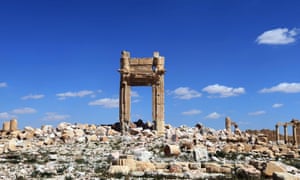
Remains of the Temple of Bel in Palmyra, once a Hellenistic place of worship, converted to a Christian church in the Byzantine era.
Remains of the Temple of Bel in Palmyra, once a Hellenistic place of worship, converted to a Christian church in the Byzantine era. Photograph: Joseph Eid/AFP/Getty Images

"The theologian," wrote Edward Gibbon in his classic The History of the Decline and Fall of the Roman Empire, "may indulge the pleasing task of describing Religion as she descended from Heaven, arrayed in her native purity. A more melancholy duty is imposed on the historian. He must discover the inevitable mixture of error and corruption, which she contracted in a long residence upon earth, among a weak and degenerate race of beings." Gibbon was a child of the European Enlightenment, and he viewed his task as a historian of early Christianity as a dispassionate, scientific one: to see things as they are, rather than as the pious would want them to be. The conclusions he reached were, perhaps inevitably, controversial in his day. The pre-Christian Roman empire, he believed, was characterised by "religious harmony", and the Romans were interested more in good governance than in imposing religious orthodoxy on their many subjects. A distinctive feature of early Christianity, by contrast, was for Gibbon its "exclusive zeal for the truth of religion", a blinkered, intolerant obsessiveness that succeeded by bullying and intimidation, and promoted a class of wide-eyed mystics. Indeed, Christian zealotry, was, he thought, ultimately responsible for the fall of the Roman empire, by creating citizens contemptuous of their public duty.

This spirit permeates Catherine Nixey's book. In her view, the standard modern picture of the Roman empire's conversion remains, even 200 years after Gibbon, glossed by Christian triumphalism. History, she believes, has given the Church an undeservedly easy ride. Pre-Christian Rome tends to be imagined as cruel, arbitrary and punitive; it is thought to be, in her fine phrase, "a chilly, nihilistic world". Christianity, conversely, is painted as brave, principled, kind, inclusive and optimistic. The task she sets herself – her own melancholy duty – is to rip away this veneer and expose the error and corruption of the early Church.

This is also, however, a book for the 21st century. What concerned Gibbon was the clash between faith and reason; for Nixey, the clashes are physical ones. This is, fundamentally, a study of religious violence. Her cover displays a statue of Athena deliberately damaged: its eyes have been gouged and its nose smashed, and a cross has been etched into its forehead. The story of this defacement is told in her prologue and reprised in her final words. The events happened in Palmyra in the late fourth century, when some of the oasis city's magnificent temples were repurposed as sites of Christian worship. Her choice to begin in Palmyra is, of course, a careful one. When she speaks of the destruction wrought on the architecture of the Syrian city by "bearded, black-robed zealots", the reader thinks not of marauding fourth-century Christian fundamentalists but of television images from recent history. "There have been," she writes, and "there still are … those who use monotheism and its weapons to terrible ends." What is revealing about that last sentence is not the connection she draws between savage practices in Christian late antiquity and in the name of Islamic State but the phrase "monotheism and its weapons". Many modern commentators like to speak of religious terrorism as a horrific distortion of religious truth; for Nixey, monotheism is always weaponised and waiting only for someone to pull the trigger.

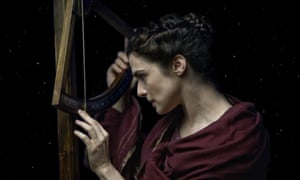
Rachel Weisz as Hypatia in the film Agora (2009) directed by Alejandro Amenábar.
Brutal end … Rachel Weisz as Hypatia in the film Agora, directed by Alejandro Amenábar. Photograph: Allstar/Cinebiss

The story of the destruction of Athena is the amuse-bouche for a feast of tales of murder, vandalism, wilful destruction of cultural heritage and general joylessness. We hear of the brutal end of Hypatia, the Alexandrian philosopher, mathematician and astronomer who was murdered by a Christian crowd in the early fifth century (an event dramatised in the Spanish movie Agora). Less well known, in the anglophone world at any rate, is the case of Shenoute. A contemporary of Hypatia's, he lived further south, in rural Egypt, where he became the abbot of the complex now known as the White Monastery (which still stands in today's town of Sohag). Shenoute is now considered a saint in the Coptic church, but his piety manifested itself in a particularly ugly guise: he was part of a gang of thugs who would break into the houses of locals whose theological views they felt to be unsound, and smash up any property they objected to on religious grounds.

Even more than the physical violence, it is the cultural devastation that draws Nixey's eye. Early in the book, she describes how she was brought up in her youth to think of late-antique and medieval Christians as enlightened curators of the classical heritage, diligently copying philosophical texts and poems throughout the ages so that they were saved from oblivion. Her views in this matter have evidently shifted somewhat over time. In this book, early Christians are much more likely to close down the academies, shut temples, loot and destroy artwork, forbid traditional practices and burn books. Rather than praising Christians for preserving slivers of classical wisdom, she argues, we should acknowledge how much was knowingly erased.

Where did this appetite for destruction come from? Nixey's short answer is a simple one: demons. Many ancient Christians believed that the world we inhabit is a perilous place, crowded with malevolent supernatural beings, who sometimes manifest themselves in the form of fake gods. It is the Christian's duty to root these out. Destroying a "pagan" statue or burning a book, then, is a no more violent act than amputating a gangrenous limb: you save the healthy whole by preventing the spread of the infection. If you think that a marble statue is possessed by a demon, then it makes a kind of sense to dig out its eyes and score a cross in its forehead. If you think, along with the North-African theologian Tertullian, that "Satan and his angels have filled the whole world" and laid traps for the virtuous in the form of sensual pleasures, then avoiding the Romans' bathhouses, dinners and spectacles is perfectly rational – as is a disdain for sexuality. The early Christian world was in a state of perpetual metaphysical war, and choosing sides inevitably meant knowing your enemies.

But demons are only half of the story. The real blame, for Nixey, lies at the door of the church fathers, whose spine-tingling sermons ramped up the polarising rhetoric of violent difference. They wove "a rich tapestry of metaphor", construing theological opponents of all kinds as bestial, verminous, diseased and – naturally – demonic. It was language itself – the forceful, lurid language of a handful of elite males – that stoked the fires of Christian rage against its enemies, fires that blazed for a millennium: "the intellectual foundations for a thousand years of theocratic oppression were being laid."

Nixey has a great story to tell, and she tells it exceptionally well. As one would expect from a distinguished journalist, every page is full of well-turned phrases that leap from the page. She has an expert eye for arresting details, and brings characters and scenarios to life without disguising anything of the strangeness of the world she describes. Most of all, she navigates through these tricky waters with courage and skill. Writing critically about Christian history is doubly difficult: not only are the ancient sources complex, scattered and disputed, but also there are legions of modern readers waiting to pounce on the tiniest perceived error, infelicity or offence.

If there is a weakness in this book, it stems precisely from its Gibbonian roots. This is, fundamentally, a restatement of the Enlightenment view that the classical heritage was essentially benign and rational, and the advent of Christianity marked civilisation's plunge into darkness (until it was fished out by Renaissance humanists). Nixey studied classics, and her affection for classical culture runs deep: she writes with great affection about the sophisticated philosophies of the stoics and epicureans, the buoyantly sexual (and not infrequently sexist) poetry of Catullus and Ovid, the bluff bonhomie of Horace and the unsentimental pragmatism of men of affairs such as Cicero and Pliny. When she speaks of classical culture and religion she tends to use such descriptions as "fundamentally liberal and generous" and "ebullient". How, then, do we explain the Romans' unfortunate habit of killing Christians? Nixey thinks, like Gibbon, that they were interested, principally, in good governance and in maintaining the civic order that the unruly Christians imperilled. Ancient accounts, she argues, show imperial officials who "simply do not want to execute"; rather, they are forced into it by the Christians' perverse lust for martyrdom. Now, martyrdom certainly has a strangely magnetic allure, as we know from our own era, but the Romans were hardly bemused, passive bystanders in all of this. There is something of the zero-sum game at work here: in seeking to expose the error and corruption of the early Christian world, Nixey comes close to veiling the pre-Christian Romans' own barbarous qualities.

But this book is not intended as a comprehensive history of early Christianity and its complex, embattled relationship to the Roman empire, and it would be unfair to judge it against that aim. It is, rather, a finely crafted, invigorating polemic against the resilient popular myth that presents the Christianisation of Rome as the triumph of a kinder, gentler politics. On those terms, it succeeds brilliantly.

• The Darkening Age is published by Macmillan. To order a copy for £17 (RRP £20) go to guardianbookshop.com or call 0330 333 6846. Free UK p&p over £10, online orders only. Phone orders min p&p of £1.99.

Since you're here…

… we have a small favour to ask. More people are reading the Guardian than ever but advertising revenues across the media are falling fast. And unlike many news organisations, we haven't put up a paywall – we want to keep our journalism as open as we can. So you can see why we need to ask for your help. The Guardian's independent, investigative journalism takes a lot of time, money and hard work to produce. But we do it because we believe our perspective matters – because it might well be your perspective, too.

I appreciate there not being a paywall: it is more democratic for the media to be available for all and not a commodity to be purchased by a few. I'm happy to make a contribution so others with less means still have access to information. Thomasine, Sweden

If everyone who reads our reporting, who likes it, helps to support it, our future would be much more secure. By supporting The Guardian – and just giving what you can afford – you can help us keep our journalism free and open to everyone, so we all have access to critical information for years to come. For as little as $1, you can support the Guardian – and it only takes a minute. Thank you.


_- Steve

The Best New Books for Spring 2018 | Outside Online

The Best New Books for Spring 2018 | Outside Online

The Best New Books for Spring 2018

Eight reads that will satisfy any reader's craving

Spring is a time to hide away your clunky winter gear, air out the house, and maybe Kondo your life into some semblance of order. At Outside, though, it's a time when our desks and mailboxes become cluttered with exciting new books. We think these eight offer a worthy excuse to fill your bookshelves—or even buy a new one, if you have to.

If You Want Fiction

'The Overstory' by Richard Powers

Richard Powers, a National Book Award winner, is perhaps the only author who could make a plot like this truly work: The book starts as a series of seemingly unrelated tales of nine people who each have a dramatic experience involving trees. That's just setting the stage for an ambitious 502 pages that explore the relationship between humans and nature and our responsibility to protect it. Powers has clearly done his research, making mention of real and recent science surrounding the inner lives of trees that would make David Haskell proud.

Buy Now

'The Life List of Adrian Mandrick' by Chris White

The novel focuses on anesthesiologist and bird obsessive Adrian Mandrick's quest to achieve the longest life list of species spotted, as well as on his abuse of painkillers. It makes for a meditation on addictions that White handles with sensibility and humor.

Buy Now

If You Want Adventure Guided by an Insider

'Critical Hours: Search and Rescue in the White Mountains' by Sandy Stott

It may come as no surprise that mishaps and rescues in New Hampshire's dangerous White Mountains could fill a book. Sandy Stott, former "accidents" editor at the Appalachian Mountain Club's journal Appalachia, has done just that with this collection of dozens of search and rescue stories from the area. But don't expect a salacious series of horror stories. Stott focuses on the heroism of SAR workers and what these incidents can teach us about staying safe in the mountains.

Buy Now

'Acid West' by Joshua Wheeler

New Mexico, from the perspective of the rest of the United States, is known for a strange and sometimes contradictory assortment of things, from romantic notions of the sprawling West to UFOs and Spaceport America. Wheeler comes at these topics from a local's perspective—he grew up in Alamogordo, and his collection of essays take place there and in surrounding areas. The pieces, which are true but can read like legends, observe the bizarre, sometimes scary, and just as often funny ways that southern New Mexico reflects America's romantic notions of a cowboy past and a space cowboy future.

Buy Now

If You Want a Little History

'Wildfire: On the Front Lines with Station 8' by Heather Hansen

Journalist Heather Hansen became a wildland certified firefighter to report this book, in which she follows a Boulder, Colorado–based wildland fire crew on their (very busy) job. The book turns out to be not just a close look at the day-to-day of an intense job, but also an excellent overview of how our current "mega-fire" era came to be.

Buy Now

'To the Edges of the Earth: 1909, the Race for the Three Poles, and the Climax of the Age of Exploration' by Edward J. Larson

You may have heard about the travails of Douglas Mawson in Antarctica, Robert Peary in the Arctic, and Luigi Amedeo on K2. But you haven't heard about them all at once in an adrenaline-fueled look at one of the wildest times in exploration, all from a Pulitzer Prize–winning historian.

Buy Now

If You Want to See What Outside's Been Up to Lately

'The Girl Who Smiled Beads: A Story of War and What Comes After' by Clemantine Wamariya and Elizabeth Weil

In the prologue of her memoir, Clemantine Wamariya recalls being a guest on Oprah years after making it to the United States, having fled the Rwandan massacre with her sister in 1994, when both of them were children. She and her sister are surprised when their entire family—whom they had not seen since 1994—show up on set. It's a complicated moment that doesn't fit neatly into the simplistic, heartrending narrative that's often forced on survivors of horrific experiences. Wamariya (along with Outside contributor Elizabeth Weil) tells the rest of her story—which, yes, is often extremely tough—with brilliance and space to grapple with her thoughts.

Buy Now

'Out There: The Wildest Stories from Outside Magazine'

Extreme bias alert: We're pretty proud of every single feature in our new anthology. Some of our favorite writers take on the quirky adventures, the doomed road trips, and the, uh, out-there characters who make our world so rich (and head-scratching). If Kevin Fedarko manning a poop boat, Taffy Brodesser-Akner going deep into the wellness industry, and Wells Tower taking a very grumpy trip to Iceland with his father don't convince you, then you probably don't have a whimsical bone in your body.

Buy Now


_- Steve

Tuesday, June 12, 2018