Wednesday, July 25, 2018

Sedona mayoral candidates go head-to-head + Fact Check - Sedona Red Rock News - Sedona News, Jobs, Things to Do

Sedona mayoral candidates go head-to-head + Fact Check - Sedona Red Rock News - Sedona News, Jobs, Things to Do

Sedona mayoral candidates go head-to-head + Fact Check

Mayor Sandy Moriarty speaks at a mayoral candidate forum on July 18. Her two challengers include Pete Conrad, right, and Tony Tonsich. The forum was jointly hosted by the League of Women Voters of Greater Verde Valley and the Sedona Chamber of Commerce and Tourism Bureau.

Top News

Three candidates running for mayor of Sedona spoke to voters during a forum July 18 at the Sedona Public Library. The forum was jointly hosted by the League of Women Voters of Greater Verde Valley and the Sedona Chamber of Commerce and Tourism Bureau.

Election 2018Pete Conrad, a six-year resident, said he's running because he's a "natural leader with proven problem-solving skills" and because he said, "It's time for a change in leadership."

Incumbent Mayor Sandy Moriarty, a 46-year resident who helped Sedona's incorporation in 1988 and served on the interim City Council, said she stands for "sound financial management, traffic improvements, sustainable tourism, protecting our natural beauty, more diverse and affordable housing and changing state law to better manage short-term rentals."

Tony Tonsich, a 27-year resident, said he's running because, "Someone had to stand up and do something."

He said he asked Arizona Rep. Brenda Barton [R-District 6] to a file SB 1487 complaint against Sedona two years ago, asked the IRS to investigate the city, has written against Home Rule on previous ballot measures and said his "last option was to run for mayor."

Making Change in Sedona

Responding to what candidates wanted to change, Moriarty said she hopes Sedona can become more sustainable; become more diverse economically, demographically and socially with more diverse housing; and regain local control.

Tonsich said he disliked "bumper-to-bumper traffic" and that "all my campaign signs were stolen within 24 hours."

Tonsich said he once asked the city for accounts payable and received a 78-page summary, then asked for it again this year and it was 480 pages.

"I don't think they wanted me to find things," he said.

According to city records, the second report Tonsich requested was "all accounts payable for FY 17-18," which is an in-depth report of all transactions. Since he requested all city transactions from all departments for the entire fiscal year, the report was 471 pages.

Tonsich said the injection well at the Wastewater Reclamation Plant "doesn't remove the pharmaceuticals; it doesn't remove any of cancer treatment drugs" and "they don't know where it's going."

Conrad said he would eliminate the Sedona in Motion projects. He proposed an automated traffic control system to relieve traffic congestion.

"It can be accomplished in a fraction of the cost of Sedona in Motion projects," he said, and "be up and running in a couple of months."

Fact Check: Wastewater

Pharmaceuticals in Sedona's effluent from human waste are within Arizona Department of Environmental Quality standards
  wastewater

Water quality is regulated by Arizona Department of Environmental Quality. The city must meet daily water quality parameters in order inject water into the ground. Sedona's wastewater effluent is tested and rated by ADEQ as A plus, the highest quality effluent it recognizes.

Regarding pharmaceuticals in Sedona's effluent from human waste, such residue measures in nanograms per milliliter, i.e., one drop of water in 13.2 million gallons.

This treated water is then injected into the ground where it can take decades to filter through the ground before entering the aquifer, which is several miles downstream from where Sedona's wells draw water.

According to a city report, various cancer drugs measured less than 100 nanograms per liter, or 100 parts per trillion [100 parts per 1,000,000,000,000]. The substance sucralose, the sugar subsitute in Splenda, measure 43,000 ng/L.

Additionally, Point of Compliance wells are specifically placed to detect the influence of spray irrigation, wetlands and injection activities on the groundwater, also an ADEQ requirement, and Sedona is in compliance with state standards.

Sustaining Quality of Life

Responding to a question about how quality of life, tourism and the environment are linked and the broad role the city and the Chamber of Commerce play in balancing quality of life, Tonsich said, "That question obviously makes a lot of assumptions and most those assumptions are incorrect."

Tonsich said residents are unhappy with their local government, the chamber overstates what it produces in tax revenue and "We need to take back control of our government."

Conrad said the key word in the question is balance.

"Tourism is the business of our town," he said. "However, our tourism cannot run over the needs of the citizens.

"We need to repurpose and redirect the chamber and the city to develop programs that use corporate, public and private partnerships to fund and execute those programs that benefit citizens as well as local tourist businesses," Conrad continued. "The chamber is a professional organization that should be given better specific direction by the city."

Conrad said the city should change focus from "day-trippers and tourists" to "tourists and vacationers."

Moriarty said, "The Chamber of Commerce, in partnership with the city, is now embarking on a long-range tourism management plan."

She said the Nichols Tourism Group and the Arizona State University Center for Sustainable Tourism will help the city and chamber balance three critical elements of tourism: Environment, which includes trails, historic buildings and heritage sites; socio-cultural, i.e., traffic mitigation and housing diversity; and economic, "to protect the thousands of jobs provided by visitors and the taxes and city receives to offset the cost of basic services."

City Staff Increase

The first audience question was about addressing the increase of city staff by 15 full-time equivalents in 2012. FTE includes adding the weekly hours of part-time staff together.

The city's FTE count prior to the Great Recession of 2008-09 was 165. In 2012, at the bottom of recession, Sedona had 117 FTE staff. In 2019, the city has 145 FTE staff.

Conrad said there's not a balance between the increase of staff and population. Conrad said the city did a good job in "raising our standards at the police department" so employee numbers are "closer to the correct staff."

Moriarty said the growth of staff is "due to the amount of economic activity that's taking place."

Moriarty said the staff dropped during the Great Recession of 2008-09 and has risen since it ended. She concurred with Conrad that the police department was understaffed for several years, and added that many vacated position were not filled.

Regarding city staff, Tonsich said, "The waste is shocking."

Tonsich said the city has three lawyers but hires an outside firm for liability cases.

Tonsich said city staff spent several hundred dollars on hotel and restaurants on Dec. 31, citing hotel and restaurant receipts, adding, "The only interesting part of this whole thing was the date — it was New Year's Eve. That's how they spend their money."

Fact Check: City Staff Receipts

Receipt 1

One New Year's Eve bill Tonsich cited was a $914.76 bill at Le Meridien Hotel.

Sedona Police Chief David McGill attended the 2017 International Association of Chiefs of Police Conference in Philadelphia, but the conference was Oct. 21 to 24, per the IACP website.

According to city records, the credit card payment should have been part of the Nov. 30 procurement card batch, but was posted in December, appearing on Dec. 31.

Credit card payments are batched at the end of the month.

Receipt 2Another New Year's Eve bill Tonsich cited was a Cartwright's restaurant charge for $603.73.

The police department held a 10-person team-building retreat for senior leadership through sergeants in Cave Creek, but it took place on Dec. 14.

This payment was part of the December procurements, also posted on Dec. 31.

In the last five years, the city has hired an Arts and Culture coordinator at 30 hours per week, a Citizen Engagement Coordinator at 35 hours, increased the PC Helpdesk technician to full time, and hired three engineers for capital projects, a dispatcher, a court clerk as municipal court volume has gone up with police activity, an economic development director and a police sergeant, as well as eight traffic control assistants and six community service traffic aides who work part-time and receive no benefits.

City and Chamber Relationship

The next audience question was about the relationship of the city and the chamber.

Moriarty said there are two parts of the chamber: The membership organization and the Tourism Bureau. Many Arizona cities have in-house tourism bureaus.

"We don't have that," she said. "We could, but I doubt if we could do it any cheaper."

Moriarty said the city has a contract with the chamber and "We have discussions about how the money will be spent," she said. "We supervise that all along … so that we know what exactly they're doing with the money."

population

Tonsich said, "These people are advertising on billboards in Phoenix and Tucson. We should be advertising in Town and Country in Architectural Digest. We should be looking for a higher-quality tourist."

"While the baby boomers are retiring en masse, this beautiful tourist town ... has lost a thousand residents," Tonsich continued.

Conrad said, "There should be a partnership, for certain, but we should always remember that it is a vendor-customer relationship. I think the chamber supplies a valuable service. I think we need to look at how much of that service needs to be directed in dollars and in focus."

According to the U.S. Census, Sedona's population growth is:
  7,844 in 1990
  8,974 in 1995
10,277 in 2000
11,189 in 2005
11,570 in 2008 just before the Great Recession
10,045 in 2010 at the lowest point in the Great Recession
10,303 in 2015 and
10,336 in 2017 (estimated)

Home Rule

"Home Rule would be a wonderful thing if you had a frugal and rational City Council," Tonsich said. "From your Dec. 31 New Year's Eve hotel stays, you can see they're anything but frugal and they're anything but paying attention."

"The city's working for the Chamber of Commerce, it's working for the city staff and citizens are a far distant third," Tonsich continued. "That's why I say no to Home Rule."

Conrad said, "I think under certain circumstances Home Rule is probably a pretty good idea because it takes the control away from the state gives it to the city, but I think you go one step further and take the control away from the city put it in the hands of the citizens. Go with the Permanent Base Adjustment."

Moriarty said she is in favor of Home Rule.

"I've heard mention here from the other two candidates that we want a citizen-run government; we don't want professional management?" Moriarty said. "Under professional management, we've had we have never had a deficit — never — we have balanced the budget every single year and we maintain a 30 percent reserve fund, which is higher than most cities."

"If you take away professional management that this makes absolutely no sense to me," Moriarty continued. "I just think it would be crazy to try and run a city some other way."

Home Rule Rebuttals

In a one-minute rebuttal to the question, Tonsich said the city has a balanced budget because it spent $10 million from its reserves fund.

He also said the city has "106 miles of roads they have to maintain" and paves a "mile a and half per year," adding it takes "more than 50 years" to repave the city's streets.

"Citizens need oversight into the budget," Conrad said. He said the city needs to find professional accountants in the community to look at the city budget.

"We pave 4 to 5 miles a year," Moriary said. "In terms of professional management, we've already have found those people. They're on our staff. They're very good."

"As far as balancing the budget ... no, we did not take $10 million out of the reserve fund," Moriarty said. "We took it out of the money we have saved. The balanced budget, according to the state, means financial resources on hand. Yes, we have a capital expense fund that we put money into we have surpluses every year, and it goes into the capital expense budget."

"We never even dipped into our reserve funds the whole time of the recession — the Great Recession — we never dipped into it," she said.

According to city officials, the city has 93 miles of city streets and repaves 4 to 5 miles of streets each year.

As indicated above, the credit card charges were were not charged on Dec. 31, 2017, they were only batched for payment on Dec. 31, 2017.

Housing Issues

The next question asked candidates what they plan to do to increase rental housing for Sedona's workforce.

Senate Bill 1350 removed the ability for towns and cities to regulate short-term vacation rentals, requiring the city to repeal a longtime ban. Sedona also had to remove a requirement for short-term rental owners to have a business license, or it risked losing about $2.1 million per year in state funds.

Moriarty said Sedona's apartment stock is "very low," about 4 percent of total housing, while the state average is 22 percent.

"Affordable housing has been in the form of single-family homes that that occupants share," Moriarty said. "With the short-term rentals taking over the town in large part, we have driven out some of those long-term rentals."

Moriarty said she is working with the state to better manage short-term rentals.

"Short-term rentals and Airbnb are a problem; they are destroying our neighborhoods," Tonsich said. "We need to not wait for the state to take action on that. You know the state says will penalize you. We need to say, 'This is our town, we're going to do something about it.'

"We pressure our state representatives enough that they're embarrassed by what they've done," Tonsich continued. "We [buy] a house next to them and rent it out with a bunch of transients five days a week."

No state legislators live in Sedona. Arizona Sen. Sylvia Allen [R-District 6] lives in Snowflake. Arizona Rep. Brenda Barton [R-District 6] lives in Safford. Arizona Rep. Bob Thorpe [R-District 6] lives in Flagstaff.

Conrad said, "Affordable housing has a lot to do with what you're capable of owning, what you're capable of paying for, and I don't think we should go a lot of a way to create affordable housing."

Traffic Problems

Regarding improving Sedona's traffic congestion, Conrad said he wants to install "pedestrian control lights" from the Sedona Art Center's Art Barn to "the other side of Tlaquepaque and synchronize those lights" allowing traffic to flow for 2 minutes and 30 seconds at a time.

He said his plan would allow 2,000 cars an hour in Uptown and cost the city $600,000, but did not cite any reports that could be independently verified.

"The city needs to stop subsidizing the chamber to advertise," Tonsich said. He said half the cars entering Sedona don't stop in town.

He said State Route 89A is considered "a failed highway from Sunset Drive to the Y" and that "State Route 89A gets more traffic than [Interstate] 17."

Moriarty said, "We have just undertaken a [public] transit study. We're definitely looking at transit as an option."

"We're going to start first with the Uptown improvements, using medians and adding a lane," she continued. "The Uptown improvements will include medians and try to stop interference from pedestrians."

"There's only two lights in Uptown so I'm not sure how many lights we could coordinate there. The other thing we're looking at is slip lanes at the Y and that will help to move traffic through that area," Moriarty said.

"We may look at underpasses, overpasses to help with pedestrian crossing," she added, but did not specify locations.

The 2016 Verde Valley Master Transportation Plan has no mention of Sunset Drive, but the stretch from Shelby Drive to the Y, which includes Shelby Drive, is listed as "near capacity" [Level of Congestion "C" and "D"] but not "failed," which is another degree higher [Level of Congestion "F"].

The average annual daily traffic on Interstate 17 is 86,261 cars, 4.82 times higher than Sedona's average of 17,882, measured near Cooks Hill.

On Sedona's busiest day, the Saturday before Memorial Day weekend 2016, Cooks Hill counted 23,804 cars, 3.26 times lower than I-17.

According to ADOT, 62 of 63 stretches on I-17 have higher AADT than Sedona, except exit 328 at Newman Park Road — parallel to State Route 89A at the switchbacks — which counts 16,870 cars.

[SEE TRAFFIC DATA IN TABLE AT THE END OF THIS STORY]

Noise Reduction

To reduce noise from ATVs, Tonsich said the city could use noise meters and task officers to go after motorcycles and quads and also cite them for not using street legal tires.

"I'm not sure how you chase an ATV all over town with the noise meter and get a reading that means something," Moriarty said. "By the time ... the police officer gets there, they're someplace else."

"ATVs are legal in this state; it doesn't matter what kind of tires they have, they're street legal," Moriarty continued. "We have tried working with the owners of the businesses that rent ATVs and we'll continue to do that."

"Tony stole my answer," Conrad said. "We need to be able to put noise reduction on the ATVs, just like there is in your cars."

ATVs are street legal by state statute, Article 28, if they have the requisite equipment: A permanent seat, headlight, brake light, a brake system, horn that can heard 200 feet away, rearview mirror, foot rest and are registered with the state. Drivers need to have a regular license and wear goggles, glasses or a face shield if there's no windshield. Drivers under 18 years old need a helmet.

Arizona Revised Statute §28-1179.A.3 allows the noise emissions to up to 96 decibels, comparable to the volume of a lawn mower. The city's OHV/ATV work group has worked with the businesses to test the ATVs in Sedona and they are all muffled below 96 decibels.

Sedona police confirm that the tires used by local businesses providing ATVs are street legal. They are unaware of any rental ATVs with illegal tires.

The city has no jurisdictional authority to change what state law permits.

Personal Motivation

The final question was, "Why do you want this job?"

"I want to serve the community," Conrad said. "I think I could do a good job and solve some of the problems.

"I think if we gather the people who live here ... to come up with a real community plan done by the community, it'll solve our problems."

Moriarty said, "The [Sedona] Community Plan was done by residents. It was a citizen committee."

"I love the job. I actually do, in spite of nights like tonight when we're hearing a lot of complaints," Moriarty continued. "I love problem-solving, I love negotiating. I'm meeting-tolerant — that's important. I'm also panic-impaired. I'm very hard to insult, by the way, so give it your best shot, it's not going to work."

Tonsich said, "It's a crime when you've got a town this beautiful with this much potential. All we need is another four years of the same thing. Many people have told me how much has changed in the last four years."

The mayor's term is two years, not four years.

Closing Statements

In closing statements, Tonsich said, "People say it's a tourist town, [so] we're going to keep developing for tourists. I disagree. People say we have a professional staff. I haven't seen it.

"It is a thankless job. I'm not looking forward to it, you know, but somebody has to do it," Tonsich continued. "If you like the way it's been going, you know, obviously vote for Sandy. If you want a politician, Pete's a politician. I'm not a politician.

"I'm sick of the lies that we [are] told by the by the chamber, by the city, you know all the things that are going on," Tonsich said.

Moriarty said, "I got bad news for Tony — it's not a four-year term, it's a two-year term. I am not a liar, in spite of what he says. I think a lot of you know that."

"I've been here 46 years. I know many of you at the town very well," she said.

"I stand for sound financial management, traffic improvements, sustainable tourism, protecting our natural beauty, more diverse and affordable housing and changing state law to better manage short-term rentals," she said.

She cited the passage of Senate Bill 1382, proposed by Sedona staff, which requires all online lodging marketplaces to remit state and local taxes for short-term rentals.

"We have a track record of balanced budgets, a strong reserve fund, no deficits and we've invested in the community," Moriarty said.

Conrad said, "I've learned there is a great talent pool of professionals — doctors, lawyers, engineers and scientists — and I'm going to ask for their support and help of those people to make Sedona a better place. Neighbors helping neighbors for our neighborhood.

"If you don't like direction that town is in, I am your candidate for change."

Christopher Fox Graham can be reached at 282-7795 ext. 129, or email editor@larsonnewspapers.com

Average Annual Daily Traffic on Interstate 17

Sedona's AADT is 17,882 cars. Only one stretch of I-17 has lower AADT than Sedona

Route BMP Start TCS MP EMP End  AADT
I 17 193.89 Exit 150A I-10 (Exit 150A) 194.4 195.07 Exit 195A 16th St (SB only) 109,275
I 17 195.07 Exit 195A 16th St (SB only) 195.17 195.99 Exit 195B 7th St (NB only) 136,369
I 17 195.99 Exit 195B 7th St (NB only) 196.18 196.93 Exit 196 7th Ave (SB only) 128,890
I 17 196.93 Exit 196 7th Ave (SB only) 197.43 197.94 Exit 197 19th Ave 122,117
I 17 197.94 Exit 197 19th Ave 198.41 199.17 Exit 199A Grant St 114,544
I 17 199.17 Exit 199A Grant St 199.34 199.71 Exit 199B Adams St 116,302
I 17 199.71 Exit 199B Adams St 199.86 200.6 Exit 200A I-10 (Exit 143A) 109,175
I 17 200.6 Exit 200A I-10 (Exit 143A) 200.7 200.88 Exit 200B Mcdowell Rd 76,628
I 17 200.88 Exit 200B McDowell Rd 200.75 201.91 Exit 201 Thomas Rd 185,782
I 17 201.91 Exit 201 Thomas Rd 202.29 202.9 Exit 202 Indian School Rd 162,148
I 17 202.9 Exit 202 Indian School Rd 203.33 203.91 Exit 203 Camelback Rd 127,440
I 17 203.91 Exit 203 Camelback Rd 204.32 204.91 Exit 204 Bethany Home Rd 164,174
I 17 204.91 Exit 204 Bethany Home Rd 205.39 205.92 Exit 205 Glendale Ave 142,639
I 17 205.92 Exit 205 Glendale Ave 206.28 206.91 Exit 206 Northern Ave 120,408
I 17 206.91 Exit 206 Northern Ave 207.52 207.97 Exit 207 Dunlap Ave 152,518
I 17 207.97 Exit 207 Dunlap Ave 208.46 208.95 Exit 208 Peoria Ave 159,310
I 17 208.95 Exit 208 Peoria Ave 209.3 209.96 Exit 209 Cactus Rd 219,582
I 17 209.96 Exit 209 Cactus Rd 210.4 210.95 Exit 210 Thunderbird Rd 214,967
I 17 210.95 Exit 210 Thunderbird Rd 211.4 211.95 Exit 211 Greenway Rd 167,089
I 17 211.95 Exit 211 Greenway Rd 212.6 212.95 Exit 212 Bell Rd 200,470
I 17 212.95 Exit 212 Bell Rd 213.62 213.98 Exit 214 Union Hills Rd 192,414
I 17 213.98 Exit 214 Union Hills Rd 214.2 214.48 Yorkshire Dr / Utopia Rd 164,237
I 17 214.48 Yorkshire Dr / Utopia Rd 214.71 214.95 Exit 215 SR 101 105,642
I 17 214.95 Exit 215 SR 101 215.21 215.49 Exit 217A Rose Garden Ln 83,475
I 17 215.49 Exit 217A Rose Garden Ln 215.71 215.99 Exit 217B Deer Valley Rd 125,219
I 17 215.99 Exit 215 Deer Valley Rd 217 217.1 Exit 217 Pinnacle Peak Rd 156,568
I 17 217.1 Exit 217 Pinnacle Peak Rd 217.5 218.02 Exit 218 Happy Valley Rd 141,159
I 17 218.02 Happy Valley Rd. 218.48 218.91 Jomax Rd 120,718
I 17 218.91 Jomax Rd 220 220.94 Dixileta Rd. 98,000
I 17 220.94 Dixileta Rd. 221.11 221.94 Sonoran Drive 110,748
I 17 221.94 Sonoran Drive 222.46 222.97 Sonoran Blvd 95,909
I 17 222.97 Sonoran Blvd 223.51 223.99 Carefree Hwy 103,894
I 17 223.99 Carefree Hwy 225 225.54 Pioneer Rd. 79,523
I 17 225.54 Pioneer Rd. 226.5 227 Daisy Mountain Rd. 77,892
I 17 227 Daisy Mountain Rd. 228.03 229.1 Anthem Way 63,820
I 17 229.1 Anthem Way 230 232.03 New River Rd. 46,866
I 17 232.03 Exit 232 New River Rd - New River 232.5 236.01 Exit 236 Table Mesa Rd / F.H. 41 44,862
I 17 236.01 Exit 236 Table Mesa Rd / F.H. 41 239 242.11 Exit 242 Rock Springs / Black Canyon City 38,481
I 17 242.11 Exit 242 Rock Springs / Black Canyon City 243.2 244.38 Exit 244 Coldwater Canyon Rd - Black Canyon City 34,014
I 17 244.38 Exit 244 Coldwater Canyon Rd - Black Canyon City 248.1 248.41 Exit 248 Bumble Bee Rd / Gowen King 34,067
I 17 248.41 Exit 248 Bumble Bee Rd / Gowen King 248.88 252.53 Exit 252 Sunset Point Rest Area 34,502
I 17 252.53 Exit 252 Sunset Point Rest Area 252.6 256.03 Exit 256 Badger Springs Rd 31,642
I 17 256.03 Exit 256 Badger Springs Rd 258.9 259.37 Exit 259 Bloody Basin Rd 36,329
I 17 259.37 Exit 259 Bloody Basin Rd 262 262.61 Exit 262 SR 69 North / Cordes Junction Rd 36,541
I 17 262.61 Exit 262 SR 69 North/ Cordes Junction Rd   263 Exit 263 Arcosanti Rd 23,394
I 17 263 Exit 262 SR 69 North / Cordes Junction Rd 268 268.94 Exit 268 Dugas Rd / Ormes Rd 26,445
I 17 268.94 Exit 268 Dugas Rd / Ormes Rd 276 278.41 Exit 278 SR 169 South / Cherry Rd 22,209
I 17 278.41 Exit 278 SR 169 South / Cherry Rd 279.22 285.54 Exit 285 General Crook Trl 34,127
I 17 285.54 Exit 285 General Crook Trl 286.2 287.29 Exit 287 SR 260 - Camp Verde / Cottonwood 26,999
I 17 287.29 Exit 287 SR 260 - Camp Verde / Cottonwood 289.12 289.98 Exit 289 Middle Verde Rd 28,494
I 17 289.98 Exit 289 Middle Verde Rd 290.65 293.27 Exit 293 Cornville Rd - McGuireville 29,256
I 17 293.27 Exit 293 Cornville Rd - McGuireville 294.6 298.99 Exit 298 SR 179 North 25,889
I 17 298.99 Exit 298 SR 179 North 303.16 306.3 Exit 306 Stoneman Lake Rd 21,465
I 17 306.3 Exit 306 Stoneman Lake Rd 309 315.58 Exit 315 Rocky Park Rd 19,432
I 17 315.58 Exit 315 Rocky Park Rd 316.12 317.87 Exit 317 Woods Canyon / Fox Ranch Rd 18,889
I 17 317.87 Exit 317 Woods Canyon / Fox Ranch Rd 319.4 320.5 Exit 320 Schnebly Hill Rd 18,625
I 17 320.5 Exit 320 Schnebly Hill Rd 322.5 322.72 Exit 322 Pinewood Blvd - Munds Park 19,850
I 17 322.72 Exit 322 Pinewood Blvd - Munds Park 323.1 326.2 Exit 326 Willard Springs Rd 19,762
I 17 326.2 Exit 326 Willard Springs Rd 327.5 328.76 Exit 328 Newman Park Rd 20,706
I 17 328.76 Exit 328 Newman Park Rd 329.6 331.1 Exit 331 Kelly Canyon Rd 16,870
I 17 331.1 Exit 331 Kelly Canyon Rd 332.37 333.85 Exit 333 Kachina Blvd / Mountainaire Rd 19,013
I 17 333.85 Exit 333 Kachina Blvd / Mountainaire Rd 335.6 337.39 Exit 337 SR 89A / Pulliam Airport Rd 23,212
I 17 337.39 Exit 337 SR 89A / Pulliam Airport Rd 338.57 339.76 Exit 339 Lake Mary Rd 33,438


_- Steve

Monday, July 23, 2018

New Study: The Genetics of Staying in School - The Atlantic

New Study: The Genetics of Staying in School - The Atlantic

An Enormous Study of the Genes Related to Staying in School

Researchers have found 1,271 gene variants associated with years of formal education. That's important, but not for the obvious reasons.

Children at Scripps Ranch KinderCare in San Diego. Robert Benson / Getty Images

When scientists publish their research, it's rare for them to write an accompanying FAQ that explains what they found and what it means. It's especially rare for that FAQ to be three times longer than the research paper itself. But Daniel Benjamin and his colleagues felt the need to do so, because they work on a topic that is frequently and easily misunderstood: the genetics of education.

Over the past five years, Benjamin has been part of an international team of researchers identifying variations in the human genome that are associated with how many years of education people get. In 2013, after analyzing the DNA of 101,000 people, the team found just three of these genetic variants. In 2016, they identified 71 more after tripling the size of their study.

Now, after scanning the genomes of 1,100,000 people of European descent—one of the largest studies of this kind—they have a much bigger list of 1,271 education-associated genetic variants. The team—which includes Peter Visscher, David Cesarini, James Lee, Robbee Wedow, and Aysu Okbay—also identified hundreds of variants that are associated with math skills and performance on tests of mental abilities.

The team hasn't discovered "genes for education." Instead, many of these variants affect genes that are active in the brains of fetuses and newborns. These genes influence the creation of neurons and other brain cells, the chemicals these cells secrete, the way they react to new information, and the way they connect with each other. This biology affects our psychology, which in turn affects how we move through the education system.

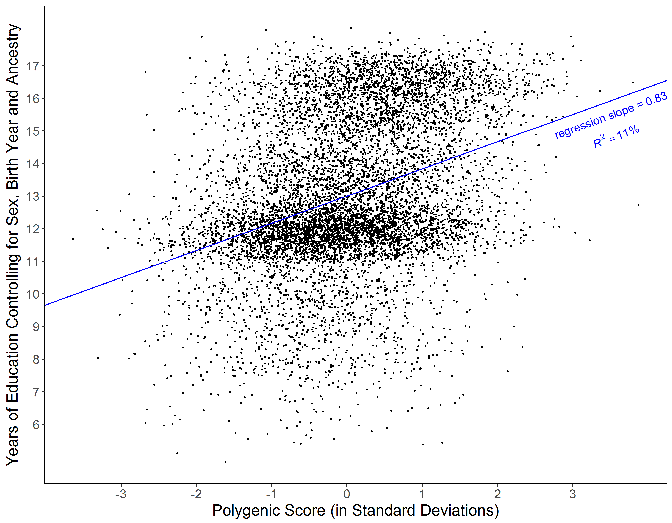
This isn't to say that staying in school is "in the genes." Each genetic variant has a tiny effect on its own, and even together, they don't control people's fates. The team showed this by creating a "polygenic score"—a tool that accounts for variants across a person's entire genome to predict how much formal education they're likely to receive. It does a lousy job of predicting the outcome for any specific individual, but it can explain 11 percent of the population-wide variation in years of schooling.

That's terrible when compared with, say, weather forecasts, which can correctly predict about 95 percent of the variation in day-to-day temperatures. But when it comes to predicting education, it's comparable to classic factors such as household income or how educated your parents are. "Within social science, that's basically unheard of," says Benjamin, who works at the University of Southern California, Los Angeles. "We can explain education as well with saliva samples as with demographics."

"Education needs to start taking these developments very seriously," says Kathryn Asbury from the University of York, who studies education and genetics. "Any factor that can explain 11 percent of the variance in how a child performs in school is very significant and needs to be carefully explored and understood."

"If we can identify genetic risks for low cognitive ability, there is an argument for putting extra provisions in place to mitigate against that disadvantage," Asbury adds. "We already do that for environmental disadvantages, such as through additional funding or free school meals. I think we need to seriously consider the implications of biological risk factors and how a fair society should respond to them."

On the flip side, there are fears that this kind of research could lead to discrimination against, or stigmatization of, people with certain genetic variants. Such fears aren't unreasonable: Many forefathers of genetics were also proponents of eugenics, advocating that people with supposedly inferior genes should be discouraged from reproducing.

Paige Harden, a clinical psychologist at the University of Texas at Austin, thinks that neither these dystopian perils nor the more beneficent applications around personalized education are realistic. "I don't think that's where we are," she says, because one still cannot use a person's DNA to accurately predict their scholastic fates.

Benjamin and his colleagues agree. Look at the graph below, which plots years of schooling against subjects' polygenic scores. Each dot is a person. Sure, on average, those with higher scores got more education than those with the lowest. But for any given score, there are huge variations in years of schooling. "Should we use the score to put some people into more advanced classes and others into more remedial classes?" says Benjamin. "That's a total nonstarter because of the low predictive power for any given individual." The same applies to mathematical prowess, or overall cognitive ability.

(Social Science Genetic Association Consortium)

And that's only for 1.1 million people of European ancestry. The score's predictive power is even lower for people of different ancestries, who likely have their own sets of education-associated variants.

"It's actually quite reassuring in showing that you could not accurately predict educational outcome from DNA," says Dorothy Bishop, a neuroscientist and geneticist at the University of Oxford. "The disturbing scenario of people screening babies in the hope of selecting the brightest does not seem supported by this study."

Indeed, Benjamin suspects that there's a ceiling of accuracy that his team has almost hit. Even if they study millions more people, he believes they won't be able to predict the educational fate of a single person with much more reliability than they can now. For that reason, the team have this to say in their FAQ:

What policy lessons or practical advice do you draw from this study?

None whatsoever. Any practical response—individual or policy-level—to this or similar research would be extremely premature and unsupported by the science.

So why bother doing the study at all?

One reason is to look at how genes and environments interact."If you did a study like ours 100 years ago, the strongest genetic predictor of education would be how many X chromosomes you had, because society was set up in a way that it was much harder for women to get educated than men," says Benjamin. Likewise, many of the genes that are associated with education today are likely important "because of how today's educational system is set up. It requires people to sit at desks for hours, and listen to instructions from a teacher. People who get restless, or are less obedient to authority, will fare less well in that environment."

Perhaps counterintuitively, Benjamin thinks that his team's research "is really important for research on improving educational systems." To understand how, forget genes for a moment, and think about wealth.

It's uncontroversial to say that people who are born into rich families are more likely to fare better in school than those from poorer backgrounds. Of course, poor kids can still soar in school, and rich ones can flunk out, but few would deny that money is a powerful influence on people's futures. Now, consider that household income explains just 7 percent of the variation in educational attainment, which is less than what genes can now account for. "Most social scientists wouldn't do a study without accounting for socioeconomic status, even if that's not what they're interested in," says Harden. The same ought to be true of our genes.

Imagine that authorities are planning to provide free preschool to kids from disadvantaged backgrounds. To see if such a policy actually helps children stay in school for longer, scientists would randomly assign the free classes to some kids but not others. Then, they would look at how the two groups fared. In doing so, they'd always try to account for factors like wealth that might also vary between the two groups. Similarly, "you can now wash away the genetic effects so you don't have to worry about them," says Benjamin. And in doing so, researchers could more precisely work out whether a policy change has any benefits—and they could do it through smaller, cheaper studies.

This, he argues, is the most powerful reason to study the genetics of education or cognitive ability—and ironically, it has very little to do with genes. Instead, it's a way of making social science more powerful.

The team is essentially studying genes so they can more thoroughly ignore them.

We want to hear what you think. Submit a letter to the editor or write to letters@theatlantic.com.


_- Steve

Sunday, July 22, 2018

What Is Consciousness? Another Reply to Kastrup | NeuroLogica Blog

What Is Consciousness? Another Reply to Kastrup | NeuroLogica Blog
Our experience of reality is demonstrably constructed by the brain. When you alter the underlying brain function, you alter that construction. People can be made to feel as if they do not control their own limbs, or that they have extra limbs, or that sound has a color, that parts of the world do not exist, that their spouse has been replaced by an imposter, or that they are one with the universe. We can do all this by poking around in the brain.

What Is Consciousness? Another Reply to Kastrup

I hadn't planned for this topic to take over my blog this week, but it happens. Judging by the comments there is significant interest in the issue of consciousness, and Kastrup and I are just getting to the real nub of the argument. So here is another installment – a reply to Kastrup's latest offering. First, however, some background.

Materialism, Dualism, and Idealism

Philosophers of mind, such as David Chalmers, now recognize three general approaches to the question – what is consciousness? Materialism is the view that the mind is what the brain does. This is often stated as the mind is caused by the brain. Some commenters took exception to this phrase, saying it implies a dualist position, that the mind is its own thing,  but I disagree. The brain is the physical substance, while the mind or consciousness is a process that emerges from the brain. A dead or deeply comatose brain has no mind, so they are manifestly not the same thing. Language here is a bit imprecise, but I think the phrase – the brain causes the mind – is an acceptable short hand for the materialist position.

Dualism is the position that consciousness is something separate from the brain and not entirely caused by it. It may be a separate property of the universe (property dualism) or be something beyond the confines of our material universe. Whatever it is, it does not reduce to the firing of neurons in the brain, which cannot, in the opinion of dualists, explain subjective experience.

The third position, the one that Kastrup holds, is idealism – the claim that consciousness is all there is and the physical universe, including the brain, is a manifestation of consciousness. Kastrup uses the metaphor of a river, where the flowing water is consciousness. The material world is like a whirlpool in the stream – the whirlpool has a definite existence in time and space, you can point to it and say, "there it is," but it is comprised entirely of the stuff of consciousness.

I am an unapologetic materialist. I think the mind is entirely explainable as a manifestation of the brain's biological function. The brain is thinking and feeling meat. I am not emotionally invested or tied to this conclusion. It would be quite cool if we were  living in a computer simulation or there was some other deeper layer to reality that would allow my consciousness to survive the death of my brain. I have simply found no compelling evidence for such a conclusion. Show me compelling evidence and a logical argument and I'll buy it – but I'm still waiting.

This does not mean, of course, that I can explain exactly how the brain generates the subjective experience of consciousness. It is important to separate the question of how the brain causes consciousness from if the brain causes consciousness. The evidence for the brain as the sole cause of the mind is, in my opinion, overwhelming. The how is a bit more tricky. I personally am on the fence between two materialist positions. One position is that the "hard problem" of consciousness, as Chalmers calls it, is really a non-problem – it is simply made of all the easy problems of neuroscience. We are making good progress in figuring out the neural correlates to the different aspects of conscious experience – motor planning, executing motor functions, primary and secondary sensory processing, visual processing, etc. The more abstract functions are more challenging, but we are making steady progress. It's possible that once we solve all these individual questions there will be nothing left – in other words, our subjective experience will be made up of all the subsets of consciousness without the need for there to be any other process that is itself consciousness. In this view consciousness is simply the real time processing of sensory input and internal communication and monitoring.

It is also possible that there is some other function within the brain that is essential to consciousness that we have not yet identified. There are theories about the "global workspace" – a distributed network in the brain that is like the central command center. Right now I think this is an open question, and I know neuroscientists of either view. Either way, it's all still brain function.

Another compelling reason to accept the materialist paradigm of neuroscience is that it has been and continues to be extremely successful. In science theories are judged not only by how well they fit the data, but by how useful they are as predictive models – and the materialist position that brain function is the mind has been fantastically successful.

There does not appear to be any intrinsic limit to our ability to map and alter anything considered to be part of our subjective experience. Damage or alteration to the brain can change your sexual identity, your moral decision making, your personality, your ability to even think about the world. Patients with non-dominant hemisphere strokes, for example, often have what is called neglect – they do not know that the left half of the world even exists. There is no model inside their brain for the left half of their body or the world, so they cannot even think about it.

Non-materialists often dismiss this as mere correlation, but that is not fair, in my opinion. The correlation is incredible, and predictive. To give just one more example, synaesthesia is the phenomenon of different sensory modalities mixing together, so synaesthetes will smell color or perhaps perceive numbers as having a physical texture. There is evidence for more robust neural connections and activity between the relevant brain areas in synaesthetes. That is a pretty compelling neural correlate.

Further still, the arrow of temporal correlation, which should go from cause to effect, seems to go from brain activity to subjective experience. Studies so far show brain firing happening prior to awareness of the subjective state.

Yet another reason I currently accept the materialist paradigm is that there is no independent evidence for anything else – for a consciousness separate the brain. There is no evidence as to what consciousness would then be, and how it interacts with the brain. Dualism and idealism are just inventing a massive mystery to explain what they perceive as another mystery, and they don't really accomplish anything. In this way non-materialist notions of consciousness are very much "god of the gaps" arguments. They are identical, in my opinion, to vitalism – the notion that there is a life force. Non-materialists start with the sense, the gut feeling, that consciousness is something different than physical matter. If you read the comments to Katrup's articles or my previous entries on this topic, or if you read dualist articles you will read this over and over – subjective experience is not material. They then proceed from that premise. This, however, is just a failure of language or imagination, not the materialist paradigm. They then essentially invent a mysterious magical consciousness that does not need to obey the laws of physics to explain consciousness. They also, therefore, are confusing unexplained with unexplainable (with regard to consciousness).

Vitalists, likewise, felt that living things had to be fundamentally different than non-living things. Life could not just be what you get when you add together all the little things that biology does. There had to be something more, some life energy which is its own thing. They then used the vital force to explain any process not currently explained by biology. Over the centuries, however, biology was eventually able to tackle all the basic functions of life. Eventually there was simply nothing left for the vital force to do. It was not so much proven wrong and rendered unnecessary – not even wrong. I believe that dualism/idealism is in the midst of suffering a similar fate.

Kastrup's Latest Reply

With that as background, let's go on to Kastrup's latest reply. I will ignore any tedious further discussion about form or tone, and simply address the key points that he is trying to make.

He writes (italics are my prior writing that he is quoting):

"The problem, from a scientific point of view, is that the notion that the brain modulates consciousness becomes operationally inseparable from the notion that the brain causes consciousness, at least in terms of the experimental relationship between brain function and mental function."

This is clearly untrue. The modulation hypothesis predicts that there are subjective mind states that do not correlate with objective brain states. Such prediction is invalid under the causation hypothesis.

I guess I was unclear in my statement above. I added the caveat, "at least in terms of the experimental relationship between brain function and mental function," specifically to account for claims of consciousness separate from brain function, but I can see that this was not sufficient. My point was that the brain as modulator hypothesis is a convenient way of explaining away all the neural correlates to consciousness, but adds nothing in terms of predictive ability or even as an explanatory model. What Kastrup is saying is that the brain as filter theory predicts imperfect correlation, but I don't see why this would be true.

What this formulation does do is set up a situation in which any anomaly in our data (imperfect correlation) can be interpreted as evidence for the modulation hypothesis. This is a very weak "prediction" – that there will be anomalies in the data. Of course there will be. The brain is horrifically complex, and our current tools for imaging brain function are relatively crude. This is really just another version of Egnor's argument that imperfect correlation is evidence of dualism – it isn't – it just reflects the limits of current technolgy and neural models.

In other words – the modulation hypothesis is unnecessary. It adds nothing to the materialist paradigm in terms of explaining or predicting how brain function will correlate to subjective experience. It adds an additional element of consciousness separate from brain function – a massive new assumption that is not justified. The best the non-materialists have is anomaly hunting – looking at current research and then focusing on studies that show imperfect correlation or some aspect of brain function that is difficult to explain with our current models. They are exploiting the leading edge of research where data is preliminary and uncertain and using it as if it were a solid and verified premise.

Further, I don't buy the modulation hypothesis explanation for the correlates we do see, including the temporal relationship of brain activation preceding awareness. How, for example, does modulation explain synaesthesia? You have to contrive a notion of modulation, again, that completely replicates the findings of strict materialism.

Kastrup continues:

"There doesn't seem to be anything coming from outside the brain – but worse, the concept is completely unnecessary. It is sliced away cleanly by Occam's razor."

This is acceptable only if one ignores the wealth of evidence for the existence of mind states uncorrelated to brain states. Novella seems to dismiss all evidence related to, for instance, Near-Death Experiences (NDEs),

This, of course, is the real crux of the matter – is there evidence for consciousness separate from brain function? I maintain that there is not. NDEs are a good example. The evidence for NDEs is mostly anecdotal. Whenever a controlled look is taken at NDEs there is no evidence that consciousness is occurring while, for example, the brain is not functioning. What we have at best are memories reported after the fact – after a long period of recovery (you don't just wake up from a cardiac arrest). During the recovery period they may form memories that are dream-like and they may interpret them as occurring during the cardiac arrest, even though they formed later. Also, during many NDE situations brain activity is not entirely lost, there are bursts of activity in different parts of the brain. Further NDE-like experiences (there is a range of experiences that are referred to as NDE) can be triggered by certain drugs, like ketamine. All of the components of NDEs can be generated by brain activity.

Kastrup and I both agree that we don't have space in this current debate for a full treatment of the NDE issue. My point, however, is simple – NDEs can be explained as brain experiences. At the very least we have to admit that the issue of NDEs is highly controversial. This is not like plate tectonics or genetics – it is not reasonable to use NDEs as if they were an accepted or solid scientific premise. They are not. In my opinion, the interpretation of NDEs as non-material is an unnecessary and fringe interpretation. Kastrup, however, wants to use it as an established premise. This is unreasonable.

About this he further writes:

My point is this: Though Novella is entitled to hold any opinion he wishes regarding the evidence available for uncorrelated mind states, the evidence is substantial enough (in the form e.g. of myriad peer-reviewed scientific publications, like van Lommel's article in The Lancet, to mention only one example) that reference to it in any debate about the  mind-body problem is legitimate; it's a legitimate point of contention. To claim otherwise is to dismiss the validity of the peer-review process, which, for obvious consistency reasons, would force Novella to equally dismiss the other scientific results he uses to justify his positions. So I do not grant Novella's claim above, which I consider arbitrary and incorrect.

I completely disagree. First, peer-review is not sufficient to establish scientific legitimacy. Much of what finds its way into the peer-reviewed literature is crap, and much of it may be good science but turns out to be wrong. What is more important than just passing the peer-review bar is what happens next – when the scientific community assesses the science. It is premature to cite NDEs as evidence for anything. They are, at best, an anomaly yet to be explained, although I think they have been adequately explained. Kastrup is simply wrong about the role of peer-review – it is not sufficient to establish legitimacy. NDEs are not a valid premise for his position – they do reveal the weakness of his position.

As as an example of my point, there are many peer-reviewed publications, even in respected journals, that deal with topics generally rejected by the scientific community.  Homeopathy is a great example. It is demonstrably absurd and wrong, and yet proponents can make the same lame legitimacy argument by citing publications in respected peer-reviewed journals and the occasional scientist who supports it. None of this adds up to homeopathy being legitimate, and I would not accept it as a premise to pronounce the demise of materialism.

The Psilocybin Study

Kastrup continues to make much about a recent study of the effects of psilocybin on the brain. This is another example of him exploiting new and controversial research as if it establishes a solid premise, and he continues to misinterpret the study. For the record, despite his complaints I have read all of the articles he linked to on this topic, I just did not find any of it cogent or compelling. But let me address his specific points in detail.

For background, psilocybin is a psychedelic drug that causes surreal hallucinations. Previous studies have found that the drug increases activity in certain parts of the brain. The new study that has Kastrup so excited found that psilocybin decreases activity in certain parts of the brain, and found no increase. Kastrup maintains this study (if confirmed) disproves the materialist paradigm because it breaks correlation between brain states and mental states. His arguments, however, are hopelessly superficial and naive of modern neuroscience – and I am not the first neuroscientist to point this out.

Here is Kastrup's full discussion of the issue. He argues that decreased brain activity cannot explain the intense experiences associated with psilocybin use within the materialist paradigm. His arguments all seem to hinge on a false assumption (although he tries to deny this) –  that the intensity of the subjective experience relates to the raw neuronal activity in the brain (the proportionality argument).

First I need to emphasize that this one study, an fMRI study, is insufficient to establish that there is no increase in any type of brain activity anywhere. This type of imaging infers brain activity by looking at a subset of metabolic processes. PET scanning looks at brain activity through different metabolic processes. Prior PET studies did show increases in brain activity with psilocybin. From the existing evidence we might conclude that some processes increase while others decrease – or we have to say that we have confilicting evidence and therefore we don't currently know what the answer is. Again – hardly appropriate to take as a premise for changing science as we know it.

But let us assume that the new study is correct and psilocybin only decreases brain activity. The neuroscientific interpretation of this is that it is reducing the modulation by one part of the brain on other parts of the brain. This is changing net subjective experience. Since processing that is involved with higher order reality testing is inhibited, it's no suprise that reality-bending experiences result. These experiences are only "intense" because they are so unreal. This does not require increased neuronal firing. In fact, reality testing and the higher cognitive functions are much more demanding than the more primitive processing that happens in the evolutionarily older parts of the brain. When the processing-intensive frontal lobes are reduced or removed from the equation, an overall lower amount of brain activity could result in wierd psychedelic and emotionally "intense" experiences. This in no way breaks the materialist predictions of correlation.

Kastrup argues that if the above explanation were true, then we would expect one of three things: First, we may see increased activity in the disinhibited areas of the brain. This is not necessarily the case, however. The activity might be the same, but since it is no longer being modulated and modified by reality testing centers the net experience can be very different.

Also – to clarify a point I made in my previous reply to Kastrup – I was not arguing that proportionality never exists when looking at brain function. My point was that proportionality does not necessarily exist in every case, and so the absense of proportionality does not break materialist correlation. There certainly is increased brain activity correlating with increased subjective mental activity, but this simple magnitude correlation does not hold when we are talking about the interaction among the various brain regions.

Kastrup further argues that if the brain regions responsible for the psychedelic experiences are not increasing their activity, then they must have been active all along, but, he argues, this makes no sense. Why would such hallucinations being going on in our subconscious all the time? He writes:

Therefore, the second scenario implies that unfathomable 'sci-fi' fantasies are subconsciously playing themselves out in our brains on a regular, on-going basis. What evolutionary advantage could this possibly have?

Not necessarily, but also it is not unreasonable that, in essence, fantasies are going on in the background all the time. Our brains are pattern recognition machines, and there is a vibrant internal conversation going on within our brains all the time. We are aware of only a small amount of what goes on in our brains. So if one tiny part of this comes into our awareness because it is no longer be crowded out by processing-heavy reality testing, that makes perfect sense. Further, the elements that make up those fantasies could be active all the time but don't manifest as narratives because they are filtered by reality testing modules. Once disinhibited, however, they contribute to our conscious narrative.

This relates somewhat to Kastrup's third point of rejection – he rejects the notion that activity in the fantasy-generating parts of the brain are active but not coalescing into coherent activity, but then once disinhibited they do. This is a bit of a straw man, based upon a simplistic understanding of brain function. He writes:

Even if we leave aside the fact that postulating such an unknown mechanism is quite contrived, this third scenario still implies that the brain activation signatures of unfathomable and mind-boggling psychedelic 'trips' are indistinguishable from ordinary, subconscious 'noise.' How reasonable a hypothesis is this, in light of the paradigmatic assumption that experience is brain activity?

I think Kastrup vastly underestimates the subconscious "noise" that is going on in the brain during normal activity.  There is a large amount of both psychological and neuroscientific evidence for the conclusion that there is a great deal of subconscious processing, including generating lots of noise. We attend demonstrably to a very small portion of this activity. Our brains select small portions of both sensory input and our internal communication to weave into a highly constructed narrative we experience as our stream of consciousness. Altering this stream significantly without changing overall brain activity makes perfect sense.

Kastrup has simply demonstrated his own naivete regarding the complex brain interactions that make up our conscious experience. His arguments all hopelessly fail for this reason. He is using preliminary and contradictory evidence as a premise, combined with false assumptions about proportionality and the meaning of things such as 'intensity' of experience, and then combining it with demonstrably wrong gut feelings about what is reasonable to assume about brain function.

Conclusion

Kastrup ends with this:

"He should at least exhibit a little tiny bit of humility when confronting neuroscientists about neuroscience"

Truths and arguments stand on their own or fail on their own. Either way, they are not determined by authority, otherwise we would still be living under the notion that the Earth is the center of the universe.

Kastrup did not give my complete quote, I actually wrote:

He should at least exhibit a little tiny bit of humility when confronting neuroscientists about neuroscience (which he does also here  – apparently I am not the first neuroscientist to call his understanding of neuroscience "naive"). This doesn't mean we're right and he's wrong, but it should at least give him pause. I know I get very concerned about my own understanding of a topic if experts in the field contradict me.

I specifically added the caveat because I knew that Kastrup would reply exactly as he did, but apparently that was not enough to dissuade him. The cheap shot was just too tempting, so he ignored what I wrote and did not include it in his quotation.

It is also interesting that he is now arguing that authority is not a reliable guide to correctness, while above he was enthusiastiacally citing peer-review and prestious journals as a source of scientific legitimacy.

I, of course, agree with his conclusion. Arguments stand or fall on their own. I think I have demonstrated that Kastrup's arguments fail at many levels. He relies upon preliminary or controversial claims as solid premises. He misunderstands the current synthesis of our neuroscientific understanding of how the brain works and how brain functioning relates to consciousness.

Our experience of reality is demonstrably constructed by the brain. When you alter the underlying brain function, you alter that construction. People can be made to feel as if they do not control their own limbs, or that they have extra limbs, or that sound has a color, that parts of the world do not exist, that their spouse has been replaced by an imposter, or that they are one with the universe. We can do all this by poking around in the brain.

Psychological manipulations can make you miss "obvious' events occuring right in front of you. Optical illusions are dramatic misperceptions of reality that can not only be correlated with brain activity they can be convincingly explained by specific information processing that happens in identifiable locations within the brain.

The obvious conclusion from all of this is unavoidable – our brains actively construct our subjective experiences.

Addendum:

Kastrup has written a reply. I am not sure it is worth another reply by me – I will decide later. He really only makes one point, represented here:

The fallacy here is that Novella talks merely of 'intensity,' while conveniently ignoring the other hallmarks of psychedelic experiences: Their structure, coherence, unfathomable complexity, and the fact that they are often described as "more real than real." (see Rick Strassman's study at the University of New Mexico's School of Medicine, described in his book The Spirit Molecule). Novella is creating a straw-man by subtly, yet massively, under-characterizing the experience, and then casually explaining such under-characterization away.

He describes the psychedelic experience over and over again as a "peak" experience. This is just more neuroscience naivete on his part. He gives no operational definition of what "peak" means (seems like just another way of saying "intense"). He doesn't address my points – I think he didn't really get them.

Psychedelic experiences are so emotionally mindblowing because they are outside of our everyday neurological experiences. They can be life changing in part because they challenge our concept of reality They reveal how constucted our reality is by deconstructing it. It may seem "realer than real" because reality testing is not functioning, telling your brain that something is not real. None of this  implies that there has to be more neuronal firing going on.

Kastrup also acknowledges my point that there is a lot of background noise in normal wakeful consciousness, but then seems to think this supports his position. He just doesn't seem to get it.

There is nothing "peak" about psychedelic experiences. They are just really different from what we are used to, because our brains are functioning differently. Some processing-intensive modules are out of the mix, like reality testing. So reality is constructed differently from anything we experience in normal wakefulness. Of course these are intense and life altering.

The bottom line is that Kastrup is making a god of the gaps argument. He can't make sense of the psilocybin research, so he is using it to support his metaphysics. His declaration that materialism is dead is premature.

Like this post? Share it!


_- Steve

Saturday, July 21, 2018

Interesting quote from "Dead Dreams (A Dakota Mystery Book 2)"

Hi - I'm reading "Dead Dreams (A Dakota Mystery Book 2)" by M.K. Coker and wanted to share this quote with you.

"Good neighbors were as prized and cultivated as state-fair-winning heifers."

Start reading it for free: http://a.co/1jmwbEL
--------
Download Kindle for Android, iOS, PC, Mac and more
http://amzn.to/1r0LubW


_- Steve

Friday, July 13, 2018

The Best Films of the 21st Century, According to Critics

The Best Films of the 21st Century, According to Critics

The Best Films of the 21st Century, According to Critics

3. Pan's Labyrinth (2006). Metacritic score: 98. Director: Guillermo del Toro. Summary: "Following a bloody civil war, young Ofelia enters a world of unimaginable cruelty when she moves in with her new stepfather, a tyrannical military officer."—Warner Bros.Picturehouse
2. Moonlight (2016). Metacritic score: 99. Director: Barry Jenkins. Summary: "Moonlight is the tender, heartbreaking story of a young man's struggle to find himself, told across three defining chapters in his life as he experiences the ecstasy, pain, and beauty of falling in love, while grappling with his own sexuality."—MetacriticA24
1. Boyhood (2014). Metacritic score: 100. Director: Richard Linklater. Summary: "Filmed over 12 years with the same cast, Richard Linklater's Boyhood is a groundbreaking story of growing up as seen through the eyes of a child named Mason (Ellar Coltrane), who literally grows up on screen before our eyes."—IFC Films IFC Films


_- Steve