Tuesday, May 29, 2018

Steven Pinker’s Ideas About Progress Are Fatally Flawed. These Eight Graphs Show Why. – Patterns of Meaning

Steven Pinker's Ideas About Progress Are Fatally Flawed. These Eight Graphs Show Why. – Patterns of Meaning

Steven Pinker's Ideas About Progress Are Fatally Flawed. These Eight Graphs Show Why.

Advertisements

It's time to reclaim the mantle of "Progress" for progressives. By falsely tethering the concept of progress to free market economics and centrist values, Steven Pinker has tried to appropriate a great idea for which he has no rightful claim.

In Enlightenment Now: The Case for Reason, Science, Humanism, and Progress, published earlier this year, Steven Pinker argues that the human race has never had it so good as a result of values he attributes to the European Enlightenment of the 18th century. He berates those who focus on what is wrong with the world's current condition as pessimists who only help to incite regressive reactionaries. Instead, he glorifies the dominant neoliberal, technocratic approach to solving the world's problems as the only one that has worked in the past and will continue to lead humanity on its current triumphant path.

His book has incited strong reactions, both positive and negative. On one hand, Bill Gates has, for example, effervesced that "It's my new favorite book of all time." On the other hand, Pinker has been fiercely excoriated by a wide range of leading thinkers for writing a simplistic, incoherent paean to the dominant world order. John Gray, in the New Statesman, calls it "embarrassing" and "feeble"; David Bell, writing in The Nation, sees it as "a dogmatic book that offers an oversimplified, excessively optimistic vision of human history"; and George Monbiot, in The Guardian, laments the "poor scholarship" and "motivated reasoning" that "insults the Enlightenment principles he claims to defend." (Full disclosure: Monbiot recommends my book, The Patterning Instinct, instead.)

In light of all this, you might ask, what is left to add? Having read his book carefully, I believe it's crucially important to take Pinker to task for some dangerously erroneous arguments he makes. Pinker is, after all, an intellectual darling of the most powerful echelons of global society. He spoke to the world's elite this year at the World's Economic Forum in Davos on the perils of what he calls "political correctness," and has been named one of Time magazine's "100 Most Influential People in the World Today." Since his work offers an intellectual rationale for many in the elite to continue practices that imperil humanity, it needs to be met with a detailed and rigorous response.

Besides, I agree with much of what Pinker has to say. His book is stocked with seventy-five charts and graphs that provide incontrovertible evidence for centuries of progress on many fronts that should matter to all of us: an inexorable decline in violence of all sorts along with equally impressive increases in health, longevity, education, and human rights. It's precisely because of the validity of much of Pinker's narrative that the flaws in his argument are so dangerous. They're concealed under such a smooth layer of data and eloquence that they need to be carefully unraveled. That's why my response to Pinker is to meet him on his own turf: in each section, like him, I rest my case on hard data exemplified in a graph.

This discussion is particularly needed because progress is, in my view, one of the most important concepts of our time. I see myself, in common parlance, as a progressive. Progress is what I, and others I'm close to, care about passionately. Rather than ceding this idea to the coterie of neoliberal technocrats who constitute Pinker's primary audience, I believe we should hold it in our steady gaze, celebrate it where it exists, understand its true causes, and most importantly, ensure that it continues in a form that future generations on this earth can enjoy. I hope this piece helps to do just that.

Graph 1: Overshoot

In November 2017, around the time when Pinker was likely putting the final touches on his manuscript, over fifteen thousand scientists from 184 countries issued a dire warning to humanity. Because of our overconsumption of the world's resources, they declared, we are facing "widespread misery and catastrophic biodiversity loss." They warned that time is running out: "Soon it will be too late to shift course away from our failing trajectory."
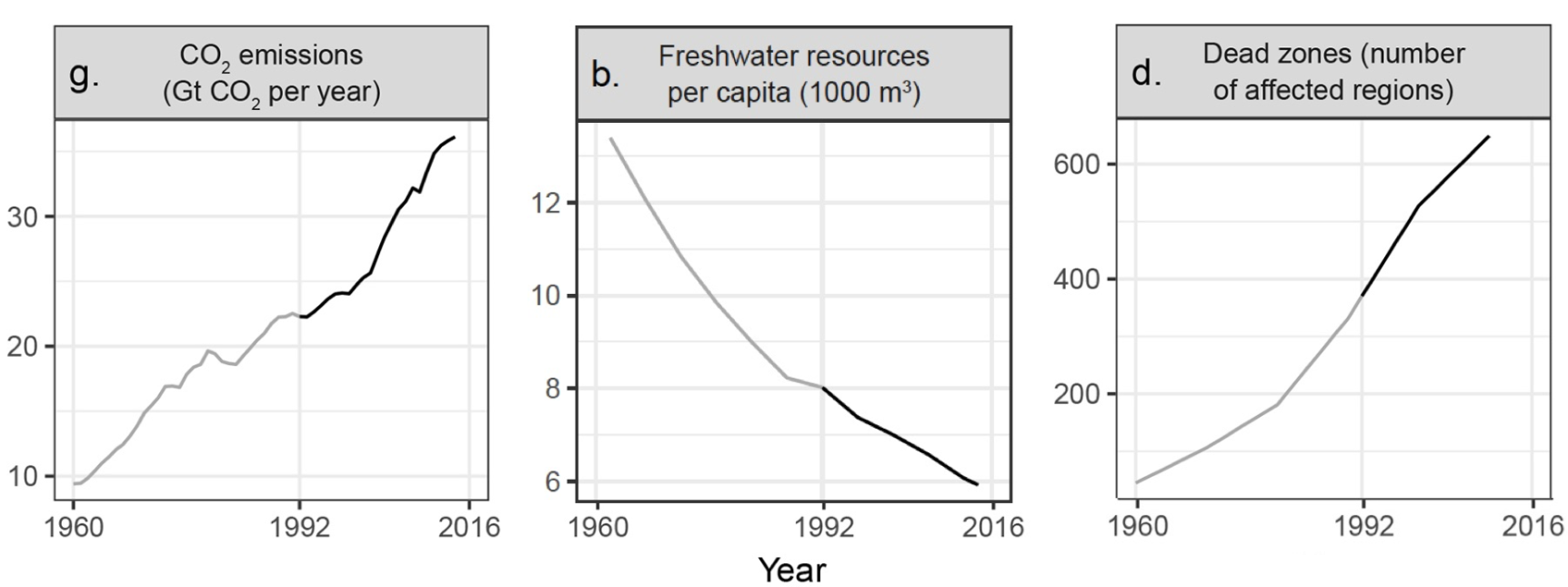
3 graphs
Figure 1: Three graphs from World Scientists' Warning to Humanity: A Second Notice

They included nine sobering charts and a carefully worded, extensively researched analysis showing that, on a multitude of fronts, the human impact on the earth's biological systems is increasing at an unsustainable rate. Three of those alarming graphs are shown here: the rise in CO2 emissions; the decline in available freshwater; and the increase in the number of ocean dead zones from artificial fertilizer runoff.

This was not the first such notice. Twenty-five years earlier, in 1992, 1,700 scientists (including the majority of living Nobel laureates) sent a similarly worded warning to governmental leaders around the world, calling for a recognition of the earth's fragility and a new ethic arising from the realization that "we all have but one lifeboat." The current graphs starkly demonstrate how little the world has paid attention to this warning since 1992.

Taken together, these graphs illustrate ecological overshoot: the fact that, in the pursuit of material progress, our civilization is consuming the earth's resources faster than they can be replenished. Overshoot is particularly dangerous because of its relatively slow feedback loops: if your checking account balance approaches zero, you know that if you keep writing checks they will bounce. In overshoot, however, it's as though our civilization keeps taking out bigger and bigger overdrafts to replenish the account, and then we pretend these funds are income and celebrate our continuing "progress." In the end, of course, the money runs dry and it's game over.

Pinker claims to respect science, yet he blithely ignores fifteen thousand scientists' desperate warning to humanity. Instead, he uses the blatant rhetorical technique of ridicule to paint those concerned about overshoot as part of a "quasi-religious ideology… laced with misanthropy, including an indifference to starvation, an indulgence in ghoulish fantasies of a depopulated planet, and Nazi-like comparisons of human beings to vermin, pathogens, and cancer." He then uses a couple of the most extreme examples he can find to create a straw-man to buttress his caricature. There are issues worthy of debate on the topic of civilization and sustainability, but to approach a subject of such seriousness with emotion-laden rhetoric is morally inexcusable and striking evidence of Monbiot's claim that Pinker "insults the Enlightenment principles he claims to defend."

When Pinker does get serious on the topic, he promotes Ecomodernism as the solution: a neoliberal, technocratic belief that a combination of market-based solutions and technological fixes will magically resolve all ecological problems. This approach fails, however, to take into account the structural drivers of overshoot: a growth-based global economy reliant on ever-increasing monetization of natural resources and human activity. Without changing this structure, overshoot is inevitable. Transnational corporations, which currently constitute sixty-nine of the world's hundred largest economies, are driven only by increasing short-term financial value for their shareholders, regardless of the long-term impact on humanity. As freshwater resources decline, for example, their incentive is to buy up what remains and sell it in plastic throwaway bottles or process it into sugary drinks, propelling billions in developing countries toward obesity through sophisticated marketing. In fact, until an imminent collapse of civilization itself, increasing ecological catastrophes are likely to enhance the GDP of developed countries even while those in less developed regions suffer dire consequences.

Graphs 2 and 3: Progress for Whom?

Which brings us to another fundamental issue in Pinker's narrative of progress: who actually gets to enjoy it? Much of his book is devoted to graphs showing worldwide progress in quality in life for humanity as a whole. However, some of his omissions and misstatements on this topic are very telling.

At one point, Pinker explains that, "Despite the word's root, humanism doesn't exclude the flourishing of animals, but this book focuses on the welfare of humankind." That's convenient, because any non-human animal might not agree that the past sixty years has been a period of flourishing. In fact, while the world's GDP has increased 22-fold since 1970, there has been a vast die-off of the creatures with whom we share the earth. As shown in Figure 2, human progress in material consumption has come at the cost of a 58% decline in vertebrates, including a shocking 81% reduction of animal populations in freshwater systems. For every five birds or fish that inhabited a river or lake in 1970, there is now just one.
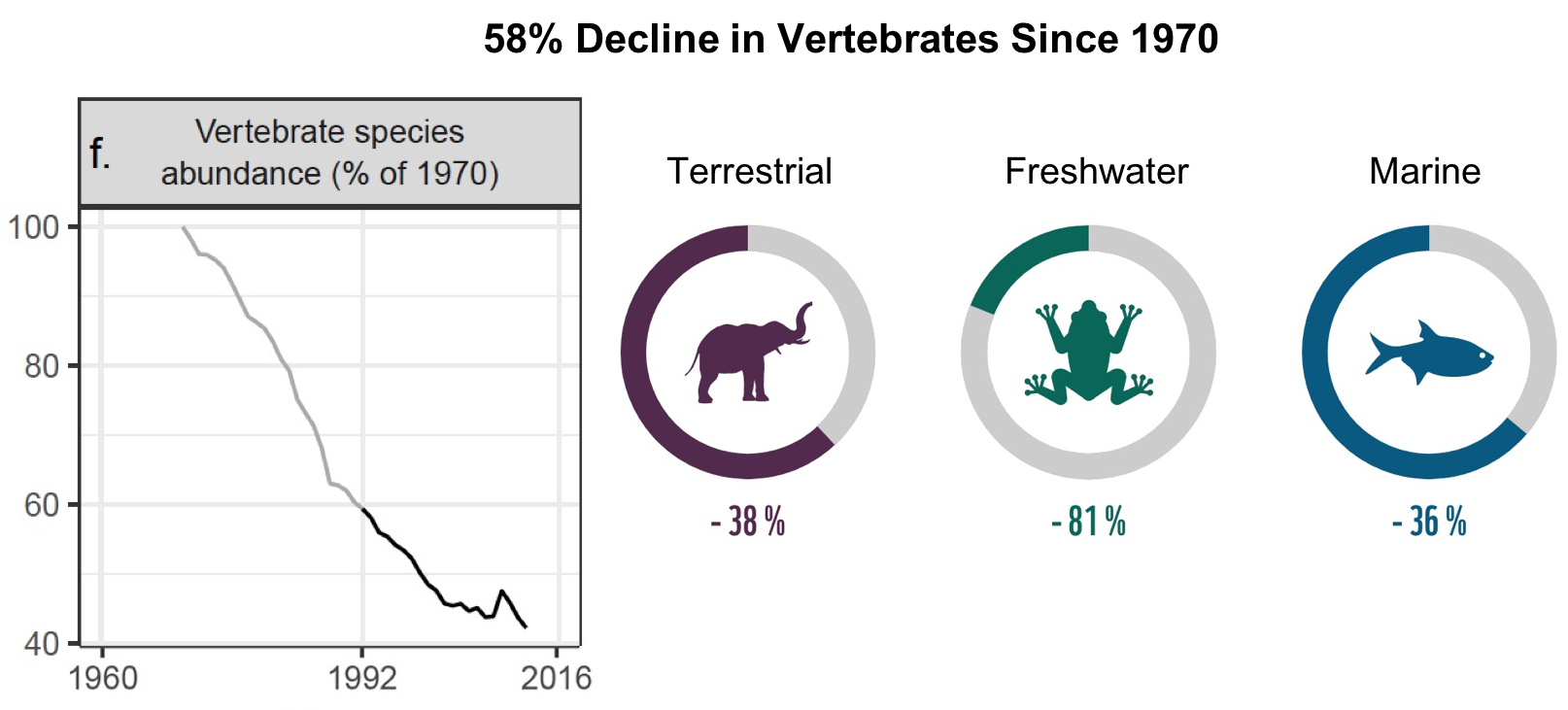
58% decline in vertebrates
Figure 2: Reduction in abundance in global species since 1970. Source: WWF Living Plant Report, 2016

But we don't need to look outside the human race for Pinker's selective view of progress. He is pleased to tell us that "racist violence against African Americans… plummeted in the 20th century, and has fallen further since." What he declines to report is the drastic increase in incarceration rates for African Americans during that same period (Figure 3). An African American man is now six times more likely to be arrested than a white man, resulting in the dismal statistic that one in every three African American men can currently expect to be imprisoned in their lifetime. The grim takeaway from this is that racist violence against African Americans has not declined at all, as Pinker suggests. Instead, it has become institutionalized into U.S. national policy in what is known as the school-to-prison pipeline.

Figure 3: Historical incarceration rates of African-Americans. Source: The Washington Post.

Graph 4: A rising tide lifts all boats?

This brings us to one of the crucial errors in Pinker's overall analysis. By failing to analyze his top-level numbers with discernment, he unquestioningly propagates one of the great neoliberal myths of the past several decades: that "a rising tide lifts all the boats"—a phrase he unashamedly appropriates for himself as he extols the benefits of inequality. This was the argument used by the original instigators of neoliberal laissez-faire economics, Ronald Reagan and Margaret Thatcher, to cut taxes, privatize industries, and slash public services with the goal of increasing economic growth.

Pinker makes two key points here. First, he argues that "income inequality is not a fundamental component of well-being," pointing to recent research that people are comfortable with differential rewards for others depending on their effort and skill. However, as Pinker himself acknowledges, humans do have a powerful predisposition toward fairness. They want to feel that, if they work diligently, they can be as successful as someone else based on what they do, not on what family they're born into or what their skin color happens to be. More equal societies are also healthier, which is a condition conspicuously missing from the current economic model, where the divide between rich and poor has become so gaping that the six wealthiest men in the world (including Pinker's good friend, Bill Gates) now own as much wealth as the entire bottom half of the world's population.

Pinker's fallback might, then, be his second point: the rising tide argument, which he extends to the global economy. Here, he cheerfully recounts the story of how Branko Milanović, a leading ex-World Bank economist, analyzed income gains by percentile across the world over the twenty-year period 1988–2008, and discovered something that became widely known as the "Elephant Graph," because its shape resembled the profile of an elephant with a raised trunk. Contrary to popular belief about rising global inequality, it seemed to show that, while the top 1% did in fact gain more than their fair share of income, lower percentiles of the global population had done just as well. It seemed to be only the middle classes in wealthy countries that had missed out.

This graph, however, is virtually meaningless because it calculates growth rates as a percent of widely divergent income levels. Compare a Silicon Valley executive earning $200,000/year with one of the three billion people currently living on $2.50 per day or less. If the executive gets a 10% pay hike, she can use the $20,000 to buy a new compact car for her teenage daughter. Meanwhile, that same 10% increase would add, at most, a measly 25 cents per day to each of those three billion. In Graph 4, Oxfam economist Mujeed Jamaldeen shows the original "Elephant Graph" (blue line) contrasted with changes in absolute income levels (green line). The difference is stark.

Figure 4: "Elephant Graph" versus absolute income growth levels. Source: "From Poverty to Power," Muheed Jamaldeen.

The "Elephant Graph" elegantly conceals the fact that the wealthiest 1% experienced nearly 65 times the absolute income growth as the poorest half of the world's population. Inequality isn't, in fact, decreasing at all, but going extremely rapidly the other way. Jamaldeen has calculated that, at the current rate, it would take over 250 years for the income of the poorest 10% to merely reach the global average income of $11/day. By that time, at the current rate of consumption by wealthy nations, it's safe to say there would be nothing left for them to spend their lucrative earnings on. In fact, the "rising tide" for some barely equates to a drop in the bucket for billions of others.

Graph 5: Measuring Genuine Progress

One of the cornerstones of Pinker's book is the explosive rise in income and wealth that the world has experienced in the past couple of centuries. Referring to the work of economist Angus Deaton, he calls it the "Great Escape" from the historic burdens of human suffering, and shows a chart (Figure 5, left) depicting the rise in Gross Domestic Product (GDP) per capita, which seems to say it all. How could anyone in their right mind refute that evidence of progress?

Figure 5: GDP per capita compared with GPI. Source: Kubiszewski et al. "Beyond GDP: Measuring and achieving global genuine progress." Ecological Economics, 2013.

There is no doubt that the world has experienced a transformation in material wellbeing in the past two hundred years, and Pinker documents this in detail, from the increased availability of clothing, food, and transportation, to the seemingly mundane yet enormously important decrease in the cost of artificial light. However, there is a point where the rise in economic activity begins to decouple from wellbeing. In fact, GDP merely measures the rate at which a society is transforming nature and human activities into the monetary economy, regardless of the ensuing quality of life. Anything that causes economic activity of any kind, whether good or bad, adds to GDP. An oil spill, for example, increases GDP because of the cost of cleaning it up: the bigger the spill, the better it is for GDP.

This divergence is played out, tragically, across the world every day, and is cruelly hidden in global statistics of rising GDP when powerful corporate and political interests destroy the lives of the vulnerable in the name of economic "progress." In just one of countless examples, a recent report in The Guardian describes how indigenous people living on the Xingu River in the Amazon rainforest were forced off their land to make way for the Belo Monte hydroelectric complex in Altamira, Brazil. One of them, Raimundo Brago Gomes, tells how "I didn't need money to live happy. My whole house was nature… I had my patch of land where I planted a bit of everything, all sorts of fruit trees. I'd catch my fish, make manioc flour… I raised my three daughters, proud of what I was. I was rich." Now, he and his family live among drug dealers behind barred windows in Brazil's most violent city, receiving a state pension which, after covering rent and electricity, leaves him about 50 cents a day to feed himself, his wife, daughter, and grandson. Meanwhile, as a result of his family's forced entry into the monetary economy, Brazil's GDP has risen.

Pinker is aware of the crudeness of GDP as a measure, but uses it repeatedly throughout his book because, he claims, "it correlates with every indicator of human flourishing." This is not, however, what has been discovered when economists have adjusted GDP to incorporate other major factors that affect human flourishing. One prominent alternative measure, the Genuine Progress Indicator (GPI), reduces GDP for negative environmental factors such as the cost of pollution, loss of primary forest and soil quality, and social factors such as the cost of crime and commuting. It increases the measure for positive factors missing from GDP such as housework, volunteer work, and higher education. Sixty years of historical GPI for many countries around the world have been measured, and the results resoundingly refute Pinker's claim of GDP's correlation with wellbeing. In fact, as shown by the purple line in Figure 5 (right), it turns out that the world's Genuine Progress peaked in 1978 and has been steadily falling ever since.

Graph 6: What Has Improved Global Health?

One of Pinker's most important themes is the undisputed improvement in overall health and longevity that the world has enjoyed in the past century. It's a powerful and heart-warming story. Life expectancy around the world has more than doubled in the past century. Infant mortality everywhere is a tiny fraction of what it once was. Improvements in medical knowledge and hygiene have saved literally billions of lives. Pinker appropriately quotes economist Steven Radelet that these improvements "rank among the greatest achievements in human history."

So, what has been the underlying cause of this great achievement? Pinker melds together what he sees as the twin engines of progress: GDP growth and increase in knowledge. Economic growth, for him, is a direct result of global capitalism. "Though intellectuals are apt to do a spit take when they read a defense of capitalism," he declares with his usual exaggerated rhetoric, "its economic benefits are so obvious that they don't need to be shown with numbers." He refers to a figure called the Preston curve, from a paper by Samuel Preston published in 1975 showing a correlation between GDP and life expectancy that become foundational to the field of developmental economics. "Most obviously," Pinker declares, "GDP per capita correlates with longevity, health, and nutrition." While he pays lip service to the scientific principle that "correlation is not causation," he then clearly asserts causation, claiming that "economic development does seem to be a major mover of human welfare." He closes his chapter with a joke about a university dean offered by a genie the choice between money, fame, or wisdom. The dean chooses wisdom but then regrets it, muttering "I should have taken the money."

Pinker would have done better to have pondered more deeply on the relation between correlation and causation in this profoundly important topic. In fact, a recent paper by Wolfgang Lutz and Endale Kebede entitled "Education and Health: Redrawing the Preston Curve" does just that. The original Preston curve came with an anomaly: the relationship between GDP and life expectancy doesn't stay constant. Instead, each period it's measured, it shifts higher, showing greater life expectancy for any given GDP (Figure 6, left). Preston—and his followers, including Pinker—explained this away by suggesting that advances in medicine and healthcare must have improved things across the board.

Figure 6: GDP vs. Life expectancy compared with Education vs. Life expectancy. Source: W. Lutz and E. Kebede. "Education and Health: Redrawing the Preston Curve." Population and Development Review, 2018

Lutz and Kebede, however, used sophisticated multi-level regression models to analyze how closely education correlated with life expectancy compared with GDP. They found that a country's average level of educational attainment explained rising life expectancy much better than GDP, and eliminated the anomaly in Preston's Curve (Figure 6, right). The correlation with GDP was spurious. In fact, their model suggests that both GDP and health are ultimately driven by the amount of schooling children receive. This finding has enormous implications for development priorities in national and global policy. For decades, the neoliberal mantra, based on Preston's Curve, has dominated mainstream thinking—raise a country's GDP and health benefits will follow. Lutz and Kebede show that a more effective policy would be to invest in schooling for children, with all the ensuing benefits in quality of life that will bring.

Pinker's joke has come full circle. In reality, for the past few decades, the dean chose the money. Now, he can look at the data and mutter: "I should have taken the wisdom."

Graph 7: False Equivalencies, False Dichotomies

As we can increasingly see, many of Pinker's missteps arise from the fact that he conflates two different dynamics of the past few centuries: improvements in many aspects of the human experience, and the rise of neoliberal, laissez-faire capitalism. Whether this is because of faulty reasoning on his part, or a conscious strategy to obfuscate, the result is the same. Most readers will walk away from his book with the indelible impression that free market capitalism is an underlying driver of human progress.

Pinker himself states the importance of avoiding this kind of conflation. "Progress," he declares, "consists not in accepting every change as part of an indivisible package… Progress consists of unbundling the features of a social process as much as we can to maximize the human benefits while minimizing the harms." If only he took his own admonition more seriously!

Instead, he laces his book with an unending stream of false equivalencies and false dichotomies that lead a reader inexorably to the conclusion that progress and capitalism are part of the same package. One of his favorite tropes is to create a false equivalency between right-wing extremism and the progressive movement on the left. He tells us that the regressive factions that undergirded Donald Trump's presidency were "abetted by a narrative shared by many of their fiercest opponents, in which the institutions of modernity have failed and every aspect of life is in deepening crisis—the two sides in macabre agreement that wrecking those institutions will make the world a better place." He even goes so far as to implicate Bernie Sanders in the 2016 election debacle: "The left and right ends of the political spectrum," he opines, "incensed by economic inequality for their different reasons, curled around to meet each other, and their shared cynicism about the modern economy helped elect the most radical American president in recent times."

Implicit in Pinker's political model is the belief that progress can only arise from the brand of centrist politics espoused by many in the mainstream Democratic Party. He perpetuates a false dichotomy of "right versus left" based on a twentieth-century version of politics that has been irrelevant for more than a generation. "The left," he writes, "has missed the boat in its contempt for the market and its romance with Marxism." He contrasts "industrial capitalism," on the one hand, which has rescued humanity from universal poverty, with communism, which has "brought the world terror-famines, purges, gulags, genocides, Chernobyl, megadeath revolutionary wars, and North Korea–style poverty before collapsing everywhere else of its own internal contradictions."

By painting this black and white, Manichean landscape of capitalist good versus communist evil, Pinker obliterates from view the complex, sophisticated models of a hopeful future that have been diligently constructed over decades by a wide range of progressive thinkers. These fresh perspectives eschew the Pinker-style false dichotomy of traditional left versus right. Instead, they explore the possibilities of replacing a destructive global economic system with one that offers potential for greater fairness, sustainability, and human flourishing. In short, a model for continued progress for the twenty-first century.

While the thought leaders of the progressive movement are too numerous to mention here, an illustration of this kind of thinking is seen in Graph 7. It shows an integrated model of the economy, aptly called "Doughnut Economics," that has been developed by pioneering economist Kate Raworth. The inner ring, called Social Foundation, represents the minimum level of life's essentials, such as food, water, and housing, required for the possibility of a healthy and wholesome life. The outer ring, called Ecological Ceiling, represents the boundaries of Earth's life-giving systems, such as a stable climate and healthy oceans, within which we must remain to achieve sustained wellbeing for this and future generations. The red areas within the ring show the current shortfall in the availability of bare necessities to the world's population; the red zones outside the ring illustrate the extent to which we have already overshot the safe boundaries in several essential earth systems. Humanity's goal, within this model, is to develop policies that bring us within the safe and just space of the "doughnut" between the two rings.

Figure 7: Kate Raworth's Doughnut Economic Model. Source: Kate Raworth; Christian Guthier/The Lancet Planetary Health

Raworth, along with many others who care passionately about humanity's future progress, focus their efforts, not on the kind of zero-sum, false dichotomies propagated by Pinker, but on developing fresh approaches to building a future that works for all on a sustainable and flourishing earth.

Graph 8: Progress Is Caused By… Progressives!

This brings us to the final graph, which is actually one of Pinker's own. It shows the decline in recent years of web searches for sexist, racist, and homophobic jokes. Along with other statistics, he uses this as evidence in his argument that, contrary to what we read in the daily headlines, retrograde prejudices based on gender, race, and sexual orientation are actually on the decline. He attributes this in large part to "the benign taboos on racism, sexism, and homophobia that have become second nature to the mainstream."

Figure 8: Racist, sexist, and homophobic Web searches, US, 2004–2017. Source: Steven Pinker, Enlightenment Now, 2018.

How, we might ask, did this happen? As Pinker himself expresses, we can't assume that this kind of moral progress just happened on its own. "If you see that a pile of laundry has gone down," he avers, "it does not mean the clothes washed themselves; it means someone washed the clothes. If a type of violence has gone down, then some change in the social, cultural, or material milieu has caused it to go down… That makes it important to find out what the causes are, so we can try to intensify them and apply them more widely."

Looking back into history, Pinker recognizes that changes in moral norms came about because progressive minds broke out of their society's normative frames and applied new ethics based on a higher level of morality, dragging the mainstream reluctantly in their wake, until the next generation grew up adopting a new moral baseline. "Global shaming campaigns," he explains, "even when they start out as purely aspirational, have in the past led to dramatic reductions in slavery, dueling, whaling, foot-binding, piracy, privateering, chemical warfare, apartheid, and atmospheric nuclear testing."

It is hard to comprehend how the same person who wrote these words can then turn around and hurl invectives against what he decries as "political correctness police, and social justice warriors" caught up in "identity politics," not to mention his loathing for an environmental movement that "subordinates human interests to a transcendent entity, the ecosystem." Pinker seems to view all ethical development from prehistory to the present day as "progress," but any pressure to shift society further along its moral arc as anathema.

This is the great irony of Pinker's book. In writing a paean to historical progress, he then takes a staunchly conservative stance to those who want to continue it. It's as though he sees himself at the mountain's peak, holding up a placard saying "All progress stops here, unless it's on my terms."

In reality, many of the great steps made in securing the moral progress Pinker applauds came from brave individuals who had to resist the opprobrium of the Steven Pinkers of their time while they devoted their lives to reducing the suffering of others. When Thomas Paine affirmed the "Rights of Man" back in 1792, he was tried and convicted in absentia by the British for seditious libel. It would be another 150 years before his visionary idea was universally recognized in the United Nations. Emily Pankhurst was arrested seven times in her struggle to obtain women's suffrage and was constantly berated by "moderates" of the time for her radical approach in striving for something that has now become the unquestioned norm. When Rachel Carson published Silent Spring in 1962, with the first public exposé of the indiscriminate use of pesticides, her solitary stance was denounced as hysterical and unscientific. Just eight years later, twenty million Americans marched to protect the environment in the first Earth Day.

These great strides in moral progress continue to this day. It's hard to see them in the swirl of daily events, but they're all around us: in the legalization of same sex marriage, in the spread of the Black Lives Matter movement, and most recently in the way the #MeToo movement is beginning to shift norms in the workplace. Not surprisingly, the current steps in social progress are vehemently opposed by Steven Pinker, who has approvingly retweeted articles attacking both Black Lives Matter and #MeToo, and who rails at the World Economic Forum against what he terms "political correctness."

It's time to reclaim the mantle of "Progress" for progressives. By slyly tethering the concept of progress to free market economics and centrist values, Steven Pinker has tried to appropriate a great idea for which he has no rightful claim. Progress in the quality of life, for humans and nonhumans alike, is something that anyone with a heart should celebrate. It did not come about through capitalism, and in many cases, it has been achieved despite the "free market" that Pinker espouses. Personally, I'm proud to be a progressive, and along with many others, to devote my energy to achieve progress for this and future generations. And if and when we do so, it won't be thanks to Steven Pinker and his specious arguments.


Jeremy Lent is author of The Patterning Instinct: A Cultural History of Humanity's Search for Meaning, which investigates how different cultures have made sense of the universe and how their underlying values have changed the course of history. He is founder of the nonprofit Liology Institute, dedicated to fostering a sustainable worldview. For more information visit jeremylent.com.

Advertisements


_- Steve

Grandma’s trauma – a critical appraisal of the evidence for transgenerational epigenetic inheritance in humans

Grandma's trauma – a critical appraisal of the evidence for transgenerational epigenetic inheritance in humans

Grandma's trauma – a critical appraisal of the evidence for transgenerational epigenetic inheritance in humans

Can molecular memories of our ancestors' experiences affect our own behaviour and physiology? That idea has certainly grabbed hold of the public imagination, under the banner of the seemingly ubiquitous buzzword "epigenetics". Transgenerational epigenetic inheritance is the idea that a person's experiences can somehow mark their genomes in ways that are passed on to their children and grandchildren. Those marks on the genome are then thought to influence gene expression and affect the behaviour and physiology of people who inherit them. 


The way this notion is referred to – both in popular pieces and in the scientific literature – you'd be forgiven for thinking it is an established fact in humans, based on mountains of consistent, compelling evidence. In fact, the opposite is true – it is based on the flimsiest of evidence from a very small number of studies with very small sample sizes and serious methodological flaws. [Note that there is, by contrast, very good evidence for this kind of mechanism in nematodes and plants and in specific circumstances involving transposable elements in mice].

To save you the trouble, I dig into the dismal details below. But first a quick tour of some recent articles in the popular press on the idea of ancestral epigenetic effects:

This one is from Discover magazine: Grandma's Experiences Leave a Mark on Your Genes

"Your ancestors' lousy childhoods or excellent adventures might change your personality, bequeathing anxiety or resilience by altering the epigenetic expressions of genes in the brain."

"According to the new insights of behavioral epigenetics, traumatic experiences in our past, or in our recent ancestors' past, leave molecular scars adhering to our DNA. Jews whose great-grandparents were chased from their Russian shtetls; Chinese whose grandparents lived through the ravages of the Cultural Revolution; young immigrants from Africa whose parents survived massacres; adults of every ethnicity who grew up with alcoholic or abusive parents — all carry with them more than just memories." 

From TIME magazine: Why Your DNA Isn't Your Destiny
"The new field of epigenetics is showing how your environment and your choices can influence your genetic code — and that of your kids"


This recent one is from the New York Review of Books: Epigenetics: The Evolution Revolution

"This mechanism can be the hidden cause of our feelings of depression, anxiety, or paranoia. What is perhaps most surprising of all, this alteration could, in some cases, be passed on to future generations who have never directly experienced the stresses that caused their forebears' depression or ill health."


And this one is from ABC Science in Australia: Epigenetics: how your life could change the cells of your grandkids

"There's a very famous well-documented case where we can clearly see the impact of famine during pregnancy on a population over generations", Professor Clark said. [Professor Susan Clark, Head of Genomics and Epigenetics at the Garvan Institute of Medical Research.] "In humans, the best example is during the WWII and the Dutch winter," she said. During WWII, the Germans cut off food supplies to parts of the Netherlands causing a famine. Professor Clark said babies born to women during this time had a lower birthweight. When those babies grew up and had their own babies, the third generation had significantly more problems with diabetes and obesity than the rest of the population."

There are dozens of others I could have chosen, from equally prominent titles. They almost all give the impression that the evidence for transgenerational epigenetic effects in humans is very strong, even if the underlying mechanisms remain mysterious. (Here is an exception, by Adam Rutherford).

Many of them go further and claim that such findings have revolutionary implications, overturning Darwinian theories of evolution, refuting genetic determinism (a straw man), and implicating epigenetics as a crucial new mechanism in medicine and public health – both a cause of disease and a potential therapeutic target.

So, let's take a look at some of these studies and see if the hype is warranted. (Spoiler: it isn't).

Here is an early one, from 2006: 

Sex-specific, male-line transgenerational responses in humans.

Pembrey ME1, Bygren LO, Kaati G, Edvinsson S, Northstone K, Sjöström M, Golding J; ALSPAC Study Team. Eur J Hum Genet.2006 Feb;14(2):159-66.

The authors state that:

We analysed food supply effects on offspring and grandchild mortality risk ratios (RR) using 303 probands and their 1818 parents and grandparents from the 1890, 1905 and 1920 Överkalix cohorts, northern Sweden… Sex-specific effects were shown in the Överkalix data; paternal grandfather's food supply was only linked to the mortality RR of grandsons, while paternal grandmother's food supply was only associated with the granddaughters' mortality RR. These transgenerational effects were observed with exposure during the SGP [slow growth phase] (both grandparents) or fetal/infant life (grandmothers) but not during either grandparent's puberty. We conclude that sex-specific, male-line transgenerational responses exist in humans and hypothesise that these transmissions are mediated by the sex chromosomes, X and Y. Such responses add an entirely new dimension to the study of gene–environment interactions in development and health.

A couple of things jump out here – first, the sample is tiny, for an epidemiological study – just 303 people. Second, the sex-specific effects were not specifically hypothesised – they just emerged from the data. They are also bizarrely arbitrary.

The authors found no general effect of grandparent's nutrition during their slow growth phase (preteen years) on the mortality of their grandchildren. What do you do when you get no main effect? Arbitrarily test some covariates, of course, and in these studies, sex is the covariate that keeps on giving, especially because as you test it in combinations across generations it exponentially increases the hypothesis space that you can gratuitously explore. In this case, the probands' paternal grandfather's nutrition had an effect (and not any of their other grandparents) but only if the proband was male. And the paternal grandmother's food supply had an effect but only if the proband was female.

Why? How? These are presented as interesting sex-specific effects and the authors hypothesise post hoc that they may involve epigenetic modifications of genes on the X and Y chromosomes, but really this is wild speculation. A more skeptical interpretation (appropriately so in my view) is that these "findings" are simply noise. They pop up as statistically significant amid a sea of non-significance, but they are in fact most likely just spurious statistical blips.

We will see this trend repeated over and over in other studies. Here's another one:

Transgenerational effects of prenatal exposure to the Dutch famine on neonatal adiposity 
and health in later life. Painter RC, Osmond C, Gluckman P, Hanson M, Phillips DI, Roseboom TJ. 
BJOG. 2008 Sep;115(10):1243-9. doi: 10.1111/j.1471-0528.2008.01822.x.

OBJECTIVE: Maternal undernutrition during gestation is associated with increased metabolic and cardiovascular disease in the offspring. We investigated whether these effects may persist in subsequent generations. DESIGN: Historical cohort study. SETTING: Interview during a clinic or home visit or by telephone. POPULATION: Men and women born in the Wilhelmina Gasthuis in Amsterdam between November 1943 and February 1947. METHODS: We interviewed cohort members (F1) born around the time of the 1944-45 Dutch famine, who were exposed or unexposed to famine in utero, about their offspring (F2). MAIN OUTCOME MEASURES: Birthweight, birth length, ponderal index and health in later life (as reported by F1) of the offspring (F2) of 855 participating cohort members, according to F1 famine exposure in utero. RESULTS: F1 famine exposure in utero did not affect F2 (n = 1496) birthweight, but, among the offspring of famine-exposed F1 women, F2 birth length was decreased (-0.6 cm, P adjusted for F2 gender and birth order = 0.01) and F2 ponderal index was increased (+1.2 kg/m(3), P adjusted for F2 gender and birth order = 0.001). The association remained unaltered after adjusting for possible confounders. The offspring of F1 women who were exposed to famine in utero also had poor health 1.8 (95% CI 1.1-2.7) times more frequently in later life (due to miscellaneous causes) than that of F1 unexposed women. CONCLUSIONS: We did not find transgenerational effects of prenatal exposure to famine on birthweight nor on cardiovascular and metabolic disease rates. F1 famine exposure in utero was, however, associated with increased F2 neonatal adiposity and poor health in later life. Our findings may imply that the increase in chronic disease after famine exposure in utero is not limited to the F1 generation but persists in the F2 generation.

Here's the table showing the data on which those findings are based:


Again, a small sample, with lots of parameters studied (e.g., causes of death, where "Other" was the only category to show a significant effect, with a tiny number of people), with no particular hypotheses about which ones are expected to show an effect, in which direction. Basically, any difference anywhere will do.

The tiny differences in that table are taken as justifying the sweeping general claim made in the title of the paper. (And of course, many people will cite it based on the title, presuming the evidence actually supports such a claim).

An interesting point about this study is that the children of F1 males who were exposed to the famine conditions around the time of their birth showed no effect on any measure. But… wait for it… a follow-up study of the exact same people later in life found an "effect" on the children of F1 males but not those of F1 females:

Transgenerational effects of prenatal exposure to the 1944-45 Dutch famine.

Veenendaal MV1, Painter RC, de Rooij SR, Bossuyt PM, van der Post JA, Gluckman PD, Hanson MA, Roseboom TJ. BJOG. 2013Apr;120(5):548-53. doi: 10.1111/1471-0528.12136. Epub 2013 Jan 24.

OBJECTIVE: We previously showed that maternal under-nutrition during gestation is associated with increased metabolic and cardiovascular disease in the offspring. Also, we found increased neonatal adiposity among the grandchildren of women who had been undernourished during pregnancy. In the present study we investigated whether these transgenerational effects have led to altered body composition and poorer health in adulthood in the grandchildren. DESIGN: Historical cohort study. SETTING: Web-based questionnaire. POPULATION: The adult offspring (F2) of a cohort of men and women (F1) born around the time of the 1944-45 Dutch famine. METHODS: We approached the F2 adults through their parents. Participating F2 adults (n = 360, mean age 37 years) completed an online questionnaire. MAIN OUTCOME MEASURES: Weight, body mass index (BMI), and health in F2 adults, according to F1 prenatal famine exposure. RESULTS: Adult offspring (F2) of prenatally exposed F1 fathers had higher weights and BMIs than offspring of prenatally unexposed F1 fathers (+4.9 kg, P = 0.03; +1.6 kg/m(2), P = 0.006). No such effect was found for the F2 offspring of prenatally exposed F1 mothers. We observed no differences in adult health between the F2 generation groups. CONCLUSIONS: Offspring of prenatally undernourished fathers, but not mothers, were heavier and more obese than offspring of fathers and mothers who had not been undernourished prenatally. We found no evidence of transgenerational effects of grandmaternal under-nutrition during gestation on the health of this relatively young group, but the increased adiposity in the offspring of prenatally undernourished fathers may lead to increased chronic disease rates in the future.

Surely these kinds of studies are not all that bad, you say. Perhaps I'm picking some particularly egregious ones? Well, no. These are the ones that get cited all the time as the evidence for transgenerational effects of famine. And I've yet to find one that is in any way convincing.

Let's do another:

Change in paternal grandmothers' early food supply influenced cardiovascular mortality of the female grandchildren. Bygren LO, Tinghög P, Carstensen J, Edvinsson S, Kaati G, Pembrey ME, Sjöström M. BMC Genet. 2014 Feb 20;15:12. doi: 10.1186/1471-2156-15-12.

Background: This study investigated whether large fluctuations in food availability during grandparents' early development influenced grandchildren's cardiovascular mortality. We reported earlier that changes in availability of food - from good to poor or from poor to good - during intrauterine development was followed by a double risk of sudden death as an adult, and that mortality rate can be associated with ancestors´ childhood availability of food. We have now studied transgenerational responses (TGR) to sharp differences of harvest between two consecutive years´ for ancestors of 317 people in Överkalix, Sweden. Results: The confidence intervals were very wide but we found a striking TGR. There was no response in cardiovascular mortality in the grandchild from sharp changes of early exposure, experienced by three of the four grandparents (maternal grandparents and paternal grandfathers). If, however, the paternal grandmother up to puberty lived through a sharp change in food supply from one year to next, her sons´ daughters had an excess risk for cardiovascular mortality (HR 2.69, 95% confidence interval 1.05-6.92). Selection or learning and imitation are unlikely explanations. X-linked epigenetic inheritance via spermatozoa seemed to be plausible, with the transmission, limited to being through the father, possibly explained by the sex differences in meiosis. Conclusion: The shock of change in food availability seems to give specific transgenerational responses.

This is another orgy of covariate mining in a tiny sample. The great thing is that you can mine by sex combinatorially across generations, so you really get extra juice out of it for dredging for "significant" results somewhere. In this case, it is supposedly an effect only on the paternal grandmother that matters – so transmitted first through the female germline and then through the male germline, AND it only affects the granddaughters, not the grandsons! That's some serious multiple testing, with no prior hypothesis, in a sample of 317 people!

There are a number of other studies along the same lines, including some looking at the supposed effects of things like grandparents smoking from an early age. They all suffer from the same problems:

1.     Very small samples

2.     Lack of predefined hypotheses

3.     Extreme, combinatorial covariate dredging (i.e., massive multiple testing)

4.     HARKing (hypothesising after results are known)

These all fall under the banner of Questionable Research Practices – the kinds of things that have filled the scientific literature in many fields with spurious findings and false positives. This is the difference between wanting to test something (good science) and wanting to find something (bad science).

Taking whatever "significant" results pop up from these kinds of analyses at face value (as opposed to seeing them for noise) leads the authors to contort themselves into some truly arcane positions, like this one: "The evidence from this study suggests that when the mother does not smoke in pregnancy the maternal grandmother's smoking habit in pregnancy has a positive association with her grandson's fetal growth." Got that? Grandma's smoking can have an effect on her daughter's (not her son's) sons (not daughters) but only if mom didn't smoke herself. 

These kinds of uber-specific scenarios are absurd on their face, to say nothing of the fact that they would require the invention of multiple new biological mechanisms to explain the sex-specific transmission (often switching from one sex to the other as it goes), as well as the sex-specific effects on grandchildren. They certainly don't justify the sweeping generalisations made in the field, when the only way to get a significant result is to carve the data eight ways.

Things don't get any better in recent papers that have attempted to identify the supposed genomic marks (thought to be mediated by DNA methylation) responsible for these supposed effects, like this one:

Grandmaternal stress during pregnancy and DNA methylation of the third generation: an epigenome-wide association study.

Serpeloni F, Radtke K, de Assis SG, Henning F, Nätt D, Elbert T. Transl Psychiatry. 2017 Aug 15;7(8):e1202. doi: 10.1038/tp.2017.153.

Abstract: Stress during pregnancy may impact subsequent generations, which is demonstrated by an increased susceptibility to childhood and adulthood health problems in the children and grandchildren. Although the importance of the prenatal environment is well reported with regards to future physical and emotional outcomes, little is known about the molecular mechanisms that mediate the long-term consequences of early stress across generations. Recent studies have identified DNA methylation as a possible mediator of the impact of prenatal stress in the offspring. Whether psychosocial stress during pregnancy also affects DNA methylation of the grandchildren is still not known. In the present study we examined the multigenerational hypothesis, that is, grandmaternal exposure to psychosocial stress during pregnancy affecting DNA methylation of the grandchildren. We determined the genome-wide DNA methylation profile in 121 children (65 females and 56 males) and tested for associations with exposure to grandmaternal interpersonal violence during pregnancy. We observed methylation variations of five CpG sites significantly associated with the grandmother's report of exposure to violence while pregnant with the mothers of the children. The results revealed differential methylation of genes previously shown to be involved in circulatory system processes. This study provides support for DNA methylation as a biological mechanism involved in the transmission of stress across generations and motivates further investigations to examine prenatal-dependent DNA methylation as a potential biomarker for health problems.

Yes, that's right – an epigenome-wide association study with a sample size of 121 – and the "cases" numbered 27. I'll just leave that there.

So, what are we to make of all this? You could be charitable and say the evidence is weak, circumstantial, observational, and correlative, and that it warrants circumspection and careful interpretation (and further research, of course!). I would go further and say that nothing in any of those papers rises to the level of what should properly be called a finding. There's no there there.

But wait, you say, what about all the animal studies that supposedly clearly show transgenerational epigenetic inheritance? Well, they suffer from all the same methodological problems as these human studies, as I have previously discussed here and here.

How data become lore

So, if these data are so terrible, why do these studies get published and cited in the scientific literature and hyped so much in the popular press? There are a few factors at work, which also apply in many other fields:

1.     The sociology of peer review. By definition, peer review is done by experts in "the field". If you are an editor handling a paper on transgenerational epigenetic inheritance in humans (or animals), you're likely to turn to someone else who has published on the topic to review it. But in this case all the experts in the field are committed to the idea that transgenerational epigenetic inheritance in mammals is a real thing, and are therefore unlikely to question the underlying premise in the process of their review. [To be fair, a similar situation pertains in most fields].

2.     Citation practices. Most people citing these studies have probably not read the primary papers or looked in detail at the data. They either just cite the headline claim or they recite someone else's citation, and then others recite that citation, and so on. It shouldn't be that way, but it is – people are lazy and trust that someone else has done the work to check whether the paper really shows what it claims to show. And that is how weak claims based on spurious findings somehow become established "facts". Data become lore.

3.     The media love a sexy story. There's no doubt that epigenetics is exciting. It challenges "dogma", it's got mavericks who buck the scientific establishment, it changes EVERYTHING about what we thought we knew about X, Y and Z, it's even got your grandmother for goodness sake. This all makes great copy, even if it's based on shaky science.

4.     Public appetite. The idea of epigenetic effects resonates strongly among many members of the general public. This is not just because it makes cute stories or is scientifically unexpected. I think it's because it offers an escape from the spectre of genetic determinism – a spectre that has grown in power as we find more and more "genes for" more and more traits and disorders. Epigenetics seems to reassure (as the headline in TIME magazine put it) that DNA is not your destiny. That you – through the choices you make – can influence your own traits, and even influence those of your children and grandchildren. This is why people like Deepak Chopra have latched onto it, as part of an overall, spiritual idea of self-realisation.

So, there you have it. In my opinion, there is no convincing evidence showing transgenerational epigenetic inheritance in humans. But – for all the sociological reasons listed above – I don't expect we'll stop hearing about it any time soon.


_- Steve

Monday, May 28, 2018

Recursivity: The Sortition Solution: Representation by Randomly-Chosen Representatives

Recursivity: The Sortition Solution: Representation by Randomly-Chosen Representatives

The Sortition Solution: Representation by Randomly-Chosen Representatives

The US political system is clearly broken. To name just a few problems:
  • the legislative agenda is largely driven, not by citizen need, but by lobbyists and special interests that can afford large political contributions;
  • corruption is rampant;
  • the budget never gets balanced because existing funded items have strong special interest support;
  • new budget items get added (but rarely removed) by special interests;
  • special interests consistently block action where there is widespread public support (e.g., gun control);
  • political parties induce a tribalist "us vs. them" mentality that leads to gridlock and an inability to deal with corruption within a party;
  • minority political viewpoints (Greens, for example) rarely get elected because they cannot achieve a majority in their district;
  • representatives are typically chosen from a small number of professions (e.g., law), while other sorts of expertise (e.g., science) are not adequately represented;
  • almost all representatives are Christians; atheists and other minority religious viewpoints are wildly under-represented;
  • incumbents have a huge advantage over challengers, even when they are clearly unfit;
  • women and minorities are wildly under-represented;
  • rural voters and interests are over-represented;
  • instead of being seen as employees doing the work of citizens, representatives become media celebrities in their own right;
  • legislators are extremely reluctant to address controversial issues, for fear of being voted out in the next election;
  • first-past-the-post voting means that candidates that most voters dislike are often elected.
Proportional representation is often proposed as a solution to some of these problems. In the most typical version of proportional representation --- party-list --- you vote for a party, not a candidate, and representatives are then chosen from a list the party provides. But this doesn't resolve the corruption and tribalism problems embodied in the first few items on my list.

My solution is exotic but simple: sortition, or random representation. Of course, it's not original with me: we use sortition today to form juries. But I would like to extend it to all legislative bodies.

Support for sortition comes from all parts of the political spectrum; William F. Buckley, Jr., for example, once said, "I am obliged to confess that I should sooner live in a society governed by the first two thousand names in the Boston telephone directory than in a society governed by the two thousand faculty members of Harvard University."

Here is a brief outline of how it would work. Legislators would be chosen uniformly and randomly from a universal, publicly-available list; perhaps a list of all registered voters.

In each election period (say 2-5 years), a random fraction of all representatives would be completely replaced, perhaps 25-50%. This would allow some institutional memory and expertise to be retained, while insuring that incumbents do not have enough time to build up fiefdoms that lead to corruption.

Sortition could be phased in gradually. For the first 10 years, sortition could be combined with a traditional electoral system, in some proportion that starts small and eventually completely replaces the traditional electoral system. This would increase public confidence in the change, as well as avoiding the problem of a "freshman class" that would be completely without experience.

I suggest that we start with small state legislatures, such as New Hampshire, as an experiment. Once the experiment is validated (and I think it would be) it could move to replace the federal system.

Advantages

Most of the problems I mentioned above would be resolved, or greatly reduced in scope.

The new legislative body would be truly representative of the US population: For example, about 50% of legislators would be women. About 13% would be black, 17% Hispanic or Latino, and 5% Asian. About 15% would be atheists, agnostics, humanists, or otherwise religiously unaffiliated.

Issues would be decoupled from parties: Right now, if you vote for the Republicans, you get lower taxes and restrictions on abortion. What if you support one but not the other? There is no way to express that preference.

Difficult legislative choices will become easier: Experiments have shown over and over that balancing the federal budget -- traditionally one of the most difficult tasks in the existing system -- turns out to be a brief and relatively trivial exercise for non-partisan citizen groups. (Here's just one such example.) Sortition would resolve this thorny problem.

One significant motivation for corruption -- getting donations for re-election -- would essentially disappear. Of course, there would be other opportunities for corruption (there always are), but at least one would be gone.

A diverse elected body would be able to consider issues from a wide variety of different perspectives. Effective action could be taken where there is widespread public support (e.g., gun control).

Objections answered

People will not want to serve: We would pay them very well -- for example, $250,000 per year. We would enact a law requiring employers to release representatives from the employment with a guarantee of re-employment after their term is over. If someone refuses to serve, we'd just move to the next person on the random list.

Sortition will produce stupid, incompetent, and dishonest representatives: Very true. Some will be stupid, some will be incompetent, and some will be dishonest. But this is also true for the existing system. (Have you ever seen Louis Gohmert being interviewed?) In my view, those with genuine expertise and leadership ability will naturally be seen as leaders by others and acquire some influence within the chamber. Stupid and incompetent people will quickly be recognized for what they are and will not have as much influence in the legislative agenda.

The public will not have trust in the selection process: Trust is a genuine issue; people will naturally distrust a new system. That's one reason to phase it in gradually. Mathematicians and theoretical computer scientists know a lot about how to sample randomly; whatever specific method is chosen would be open-source and subject to scrutiny. To make a truly random choice even more convincing, a combination of different methods could be used. For example, we could use algorithmic methods to choose a sample of (say) a thousand names. Then we could use physical means (for example, the ping-pong balls used for lotteries) to choose 200 names of the legislators from this group.

The legislative agenda will not be clear: Political parties offer a legislative agenda with priorities, but where will the agenda come under sortition? My answer is that the major issues of the day will generally be clear. For example, today's issues include anthropogenic global warming, terrorism, immigration, wage stagnation, and health care, to name just five. These are clear issues of concern that can be seen without the need of a political party's ideology. The existing federal and state bureaucracies -- civil servants -- will still be there to offer expertise.

People will feel like they have no voice: Without elections, how do people feel their voice is heard? Another legitimate objection. This suggests considering some sort of mixed system, say, with 50% of representatives chosen by sortition and 50% chosen by election. Or perhaps two different legislative bodies, one based on sortition and one based on election. We have to be willing to experiment and innovate.

Sortition should be seriously considered.


_- Steve